
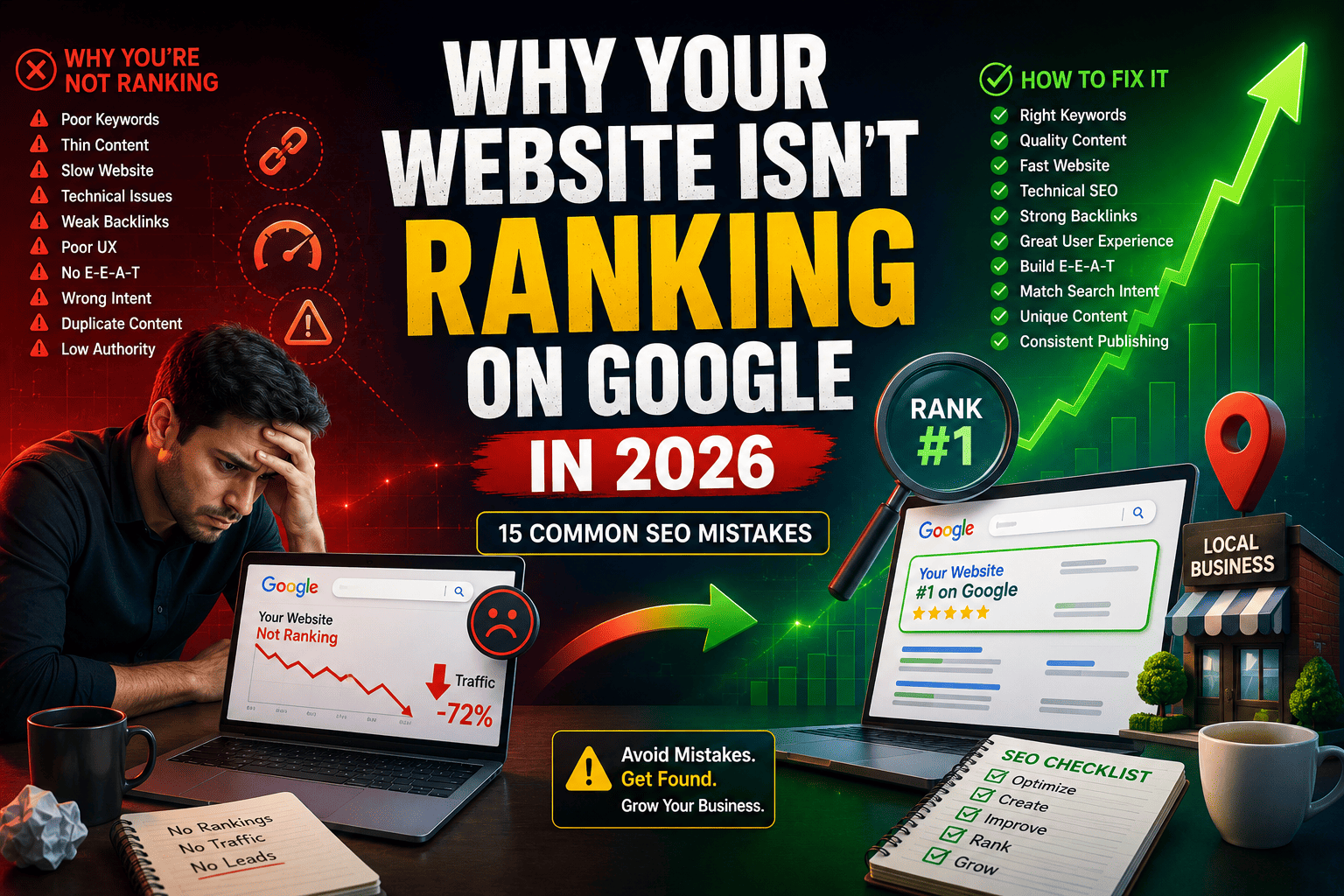
Every business wants to appear on the first page of Google, but many websites struggle to rank despite investing time and money into SEO. Search engine optimization has evolved significantly over the past few years, and what worked a few years ago may no longer deliver results.
If your website isn't ranking on Google in 2026, you're not alone. The good news is that most ranking issues can be identified and fixed. In this guide, we'll explore the 15 most common SEO mistakes that prevent websites from achieving higher rankings and explain how to overcome them.
1. Targeting the Wrong Keywords
Many businesses try to rank for highly competitive keywords without considering search intent or keyword difficulty.
Instead of targeting only broad terms like SEO Services, include long-tail keywords that match what your customers are actually searching for.
2. Publishing Thin Content
Google rewards content that provides real value.
Pages with only a few hundred words or generic information rarely perform well.
Create comprehensive, informative content that answers users' questions in detail.
3. Ignoring Search Intent
Understanding what users expect when they search is essential.
If someone searches for Best SEO Company in India, they expect comparisons, services, pricing and expertise—not a short promotional paragraph.
4. Slow Website Speed
A slow-loading website leads to higher bounce rates and poor user experience.
Improve performance by:
- Compressing images
- Using browser caching
- Minimizing CSS and JavaScript
- Choosing reliable hosting
5. Poor Mobile Experience
Google primarily indexes the mobile version of websites.
Ensure your website is:
- Mobile responsive
- Easy to navigate
- Fast on smartphones
- Free from layout issues
6. Weak Internal Linking
Internal links help search engines discover your content and understand relationships between pages.
Link related service pages, blog posts and location pages wherever appropriate.
7. No Topical Authority
Publishing random blog posts isn't enough.
Instead, create multiple high-quality articles around the same subject.
For example, an SEO website should cover:
- AI SEO
- Technical SEO
- Link Building
- Content Marketing
- Google Business Profile
- SEO Audits
- Website Optimization
This helps establish expertise in your niche.
8. Poor Technical SEO
Technical problems can prevent Google from properly crawling your website.
Common issues include:
- Broken links
- Redirect errors
- Missing meta tags
- Duplicate pages
- Incorrect canonical tags
- Crawl errors
Regular technical audits help identify and fix these problems.
9. Low-Quality Backlinks
Not all backlinks improve rankings.
Avoid spammy directories and focus on earning links from:
- Industry websites
- Business publications
- Trusted blogs
- Relevant directories
Quality always outweighs quantity.
10. Missing E-E-A-T Signals
Google values websites that demonstrate:
- Experience
- Expertise
- Authoritativeness
- Trustworthiness
Showcase your experience through case studies, client testimonials, detailed service pages and helpful educational content.
11. Poor User Experience
A confusing website makes visitors leave quickly.
Improve usability by:
- Clear navigation
- Readable fonts
- Fast loading pages
- Simple layouts
- Easy-to-find contact information
A better user experience often leads to improved rankings.
12. Publishing AI Content Without Human Editing
AI tools can help create content faster, but publishing AI-generated text without reviewing it can reduce quality.
Always edit, fact-check and add your own expertise before publishing.
13. Inconsistent Content Publishing
Google prefers websites that remain active.
Publishing useful blogs regularly signals that your website is current and relevant.
A consistent publishing schedule also increases crawl frequency.
14. Ignoring On-Page SEO
Every page should include:
- Optimized title tag
- Compelling meta description
- Proper H1 heading
- Logical heading structure
- Image alt text
- Internal links
Small improvements across multiple pages can make a significant difference.
15. Expecting Instant Results
SEO is a long-term investment.
Depending on your industry and competition, noticeable improvements may take several months. Consistency, quality content and technical optimization are the keys to sustainable growth.
How to Improve Your Rankings
If your website isn't ranking well, focus on:
- Publishing high-quality content
- Improving technical SEO
- Building topical authority
- Earning quality backlinks
- Optimizing user experience
- Monitoring performance through Google Search Console
These practices help create a strong foundation for long-term SEO success.
Conclusion
Ranking on Google in 2026 requires more than simply adding keywords to your pages. Search engines reward websites that provide valuable content, excellent user experiences and trustworthy information.
By avoiding these common SEO mistakes and continuously improving your website, you'll be in a much stronger position to increase visibility, attract qualified traffic and generate more business through organic search.