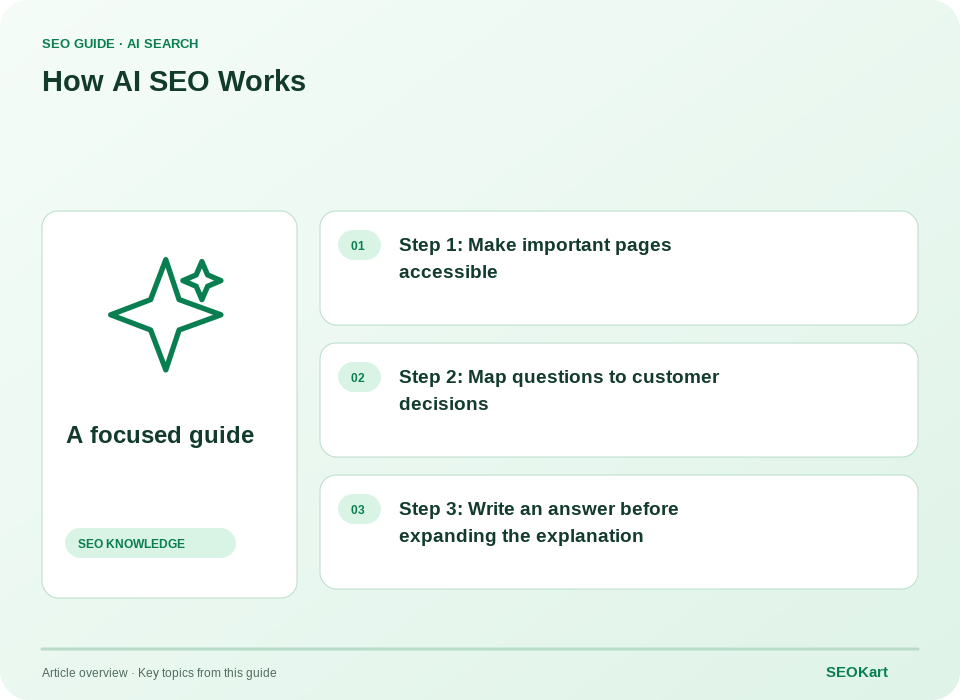
AI SEO is the work of making a business website useful and understandable to both conventional search engines and AI-assisted discovery tools. It is not a separate technical trick or a guaranteed way to appear in an AI-generated answer. The practical starting point is to publish accessible, accurate information that answers the questions buyers actually ask.
Step 1: Make important pages accessible
Check that service pages return a successful response, use a consistent canonical URL and can be discovered through navigation and relevant internal links. Review robots directives and accidental noindex tags. A page that cannot be fetched or indexed is unlikely to contribute meaningfully to organic discovery. Start with a technical SEO review before commissioning more articles.
Step 2: Map questions to customer decisions
Collect questions from enquiries, sales calls, search queries and competitor comparisons. Separate informational questions such as “what does this service include?” from commercial questions such as “how much does it cost?” Give each important question a clear home rather than repeating a generic answer on every page. For more detail on this related topic, see AI SEO Guide for Indian Businesses: What to Optimise.
Step 3: Write an answer before expanding the explanation
Open each section with a direct response, then provide evidence, examples, limitations and next steps. Explain acronyms and specify geography, currency and scope where relevant. Useful answers are easier for readers to evaluate and easier for automated systems to interpret.
Step 4: Clarify entities and relationships
Identify the company, its services, locations and specialisms consistently. Link the company profile to relevant service pages, case studies and contact details. Use structured data only when it accurately reflects visible content; schema markup cannot compensate for missing or misleading information.
Step 5: Build connected topic coverage
A main service page should describe the offer, deliverables, process and commercial next step. Supporting articles can explain implementation, costs, mistakes and comparisons. Link each article to the most relevant service, such as AI SEO services, using descriptive anchors. For more detail on this related topic, see AI SEO in 2026: What Businesses Should Actually Prioritise.
Step 6: Measure what can be observed
Track Google Search Console impressions, clicks, query themes and landing pages. Separately document any verifiable AI referrals or citations where measurement is possible. Do not treat a chatbot mentioning a brand once as proof of stable rankings. Review performance over meaningful time windows rather than a single day.
What should a business do first?
Audit five high-value pages, improve their direct answers and internal links, and then assess changes in search visibility. Prioritise accurate service information over mass-produced articles. For a structured assessment, explore SEOKart's SEO audit services.