How We Turn an SEO Audit Into a Practical Work Plan
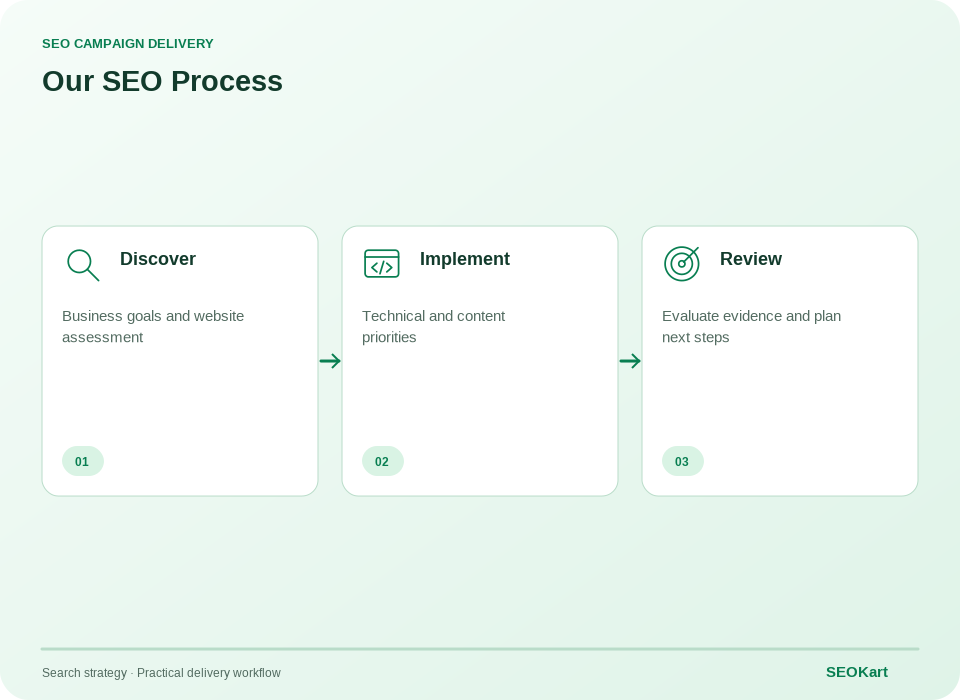
Our process begins with business goals and a baseline of existing organic visibility, enquiries and technical health. We then prioritise changes by likely impact and implementation effort. Fixing indexing or important service-page issues often matters more than publishing large volumes of low-value content. Each recommendation should have a clear owner, expected outcome and method of checking progress.
Review, Implement, Measure and Refine
A typical cycle includes discovery, keyword and intent mapping, technical checks, on-page improvements, content planning, internal linking and periodic performance reviews. We explain what has changed, what remains blocked and what the available data can—and cannot—prove. Search rankings and lead volumes vary, so our reporting focuses on completed work, qualified traffic and useful business outcomes rather than guaranteed positions.
Learn more about our SEO audit services and SEO results and reporting guide.
At SEOKart, SEO is a structured and continuous process designed to improve search visibility, attract relevant visitors and support long-term business growth. Effective SEO requires more than optimising a few keywords or publishing occasional content. It involves understanding the business, analysing the website, researching search behaviour, fixing technical issues, strengthening important pages, building authority and continuously measuring performance.
Our SEO process combines Technical SEO, On-Page SEO, Keyword Research, AI SEO, Local SEO, Content Marketing and Link Building, with conversion-focused optimisation where appropriate.
Understanding Your Business Comes First
Before making changes to a website, we first need to understand what the business is trying to achieve.
We look at your products and services, target audience, industry, competitors, target locations, existing online presence, current SEO performance and lead-generation objectives. This initial discovery helps us understand where organic search fits within the wider business strategy.
A local service business targeting customers in Delhi, for example, requires a different SEO approach from an ecommerce website selling throughout India or a SaaS company targeting customers internationally.
The SEO strategy is therefore developed around the actual business, customers and search market rather than applying the same process to every website.
Comprehensive SEO Audit
Once we understand the business, we assess the website to identify problems and opportunities that could affect organic search performance.
SEOKart's SEO Audit examines seven core areas: On-Page SEO, Technical SEO, Performance, Accessibility, Images, Structured Data and Security.
On-page analysis can cover title tags, meta descriptions, heading structure, content optimisation, keyword usage and internal linking. Technical analysis examines areas such as crawlability, indexation, canonical URLs, redirects, XML sitemaps and website architecture.
We also review page speed, Core Web Vitals and mobile performance, along with accessibility and usability factors. Images can be assessed for optimisation, alt text, formats, size and performance, while structured data analysis can identify schema issues and rich-result opportunities. HTTPS, security configuration, security signals and potential website security issues form the final part of the audit.
The objective is to establish a clear technical and content foundation before deciding which improvements should be prioritised.
Keyword Research Based on Search Intent
Keyword research helps determine how potential customers search for the products, services and information a business provides.
We consider search intent, demand, competition, commercial relevance, long-tail searches, location-based searches, industry terminology and customer questions.
However, identifying keywords is only part of the process. Relevant terms must also be mapped to the right pages.
A commercial service keyword may belong on a service page, a geographically specific search may require a relevant location page, while an informational question may be better addressed through a detailed article or supporting resource.
This keyword-to-page mapping helps prevent unrelated pages from competing for the same search intent and provides a clearer structure for future optimisation.
Competitor SEO Analysis
Search results are competitive, so understanding what other websites are doing can reveal opportunities that are difficult to identify by analysing your own website alone.
SEOKart can examine competitor keywords, ranking pages, content coverage, search visibility, backlink profiles, keyword gaps, content gaps and authority signals.
Competitor analysis does not mean simply copying another website. Its purpose is to understand the search environment, identify areas competitors cover effectively and uncover relevant opportunities your website may currently be missing.
Building the SEO Strategy
The findings from business discovery, the SEO audit, keyword research and competitor analysis are brought together into a structured SEO roadmap.
Depending on the website, the strategy can combine Technical SEO, On-Page SEO, Content Marketing, Internal Linking, Local SEO, Link Building, AI SEO and Conversion Optimisation.
Priorities depend on the website's actual condition. A technically weak website may require foundational fixes before significant content expansion, while an established site with a strong technical foundation may have greater opportunities through content, internal linking, authority building or new keyword coverage.
This prevents SEO from becoming a disconnected checklist of activities.
Technical SEO Builds the Foundation
Search engines need to be able to efficiently crawl, understand and index the pages that matter.
Our Technical SEO Services can address crawlability, indexation, XML sitemaps, robots.txt, canonical URLs, redirects, broken links, URL structure, website architecture, mobile usability, Core Web Vitals and structured data.
Technical optimisation becomes particularly important as websites grow. Ecommerce stores, large service websites, SaaS platforms, multi-location businesses and content-heavy sites can develop structural and indexation issues that affect how search engines process their pages.
The goal is to provide a technically sound foundation for the content and authority work that follows.
On-Page SEO Aligns Pages With Search Intent
Once the technical foundation has been assessed, individual pages can be improved around their intended search purpose.
On-Page SEO can involve page titles, meta descriptions, H1 and supporting headings, content optimisation, keyword placement, search-intent alignment, internal links, images, schema recommendations and calls to action.
The objective is not to repeatedly insert keywords. Important pages should clearly communicate what they offer, answer relevant customer needs and provide search engines with enough context to understand their subject.
Content Expands Organic Search Visibility
A website cannot rank for every relevant search through a handful of service pages.
Content strategy allows businesses to expand their search presence through service pages, industry pages, location pages, blog articles, pillar content, topic clusters, supporting resources, FAQs and thought-leadership content where those formats are relevant.
We focus on genuine search intent and customer needs rather than publishing content simply to increase the number of indexed pages.
Commercial pages can target people actively looking for a product or service, while supporting informational content can answer questions earlier in the customer journey and strengthen topical coverage around important business areas.
Internal Linking Connects the Website
Internal linking helps search engines and users move between related information across a website.
A structured internal-linking strategy can connect service pages, industry pages, location pages, blog articles, pillar content, supporting resources and commercial landing pages.
For example, a useful informational article can link naturally to a relevant service page, while related service and industry pages can reinforce the broader structure of the website.
Internal linking is therefore treated as part of website architecture and content strategy rather than something added randomly after pages have been published.
Local SEO for Location-Based Searches
For businesses serving specific cities, regions or service areas, the SEO process can incorporate Local SEO.
This can involve Google Business Profile optimisation, local keyword research, location-page optimisation, local citations, review strategy recommendations, local content, local link opportunities and competitor analysis.
Local SEO is particularly relevant when customers search using geographic terms or searches such as "near me." The strategy should reflect genuine business locations and service areas rather than creating unnecessary duplicate location pages.
Building Relevant Website Authority
Strong content and technical optimisation may need to be supported by external authority.
SEOKart's Link Building Services can involve backlink analysis, competitor backlink research, link-gap analysis, prospect research, manual outreach, contextual links, guest posts, editorial opportunities, digital PR and linkable assets.
We prioritise relevance and quality rather than simply acquiring large numbers of backlinks.
The purpose of authority building is to strengthen the website through legitimate and relevant opportunities that support the wider SEO strategy.
AI SEO for Emerging Search Experiences
Search increasingly includes AI-powered results, generative search and answer engines alongside traditional search listings.
Where appropriate, SEOKart incorporates AI SEO, Generative Engine Optimisation and Answer Engine Optimisation into the wider campaign.
This can involve entity optimisation, topical authority, conversational content, structured information and content designed to clearly communicate businesses, services, products and expertise to modern search systems.
AI SEO complements traditional SEO rather than replacing Technical SEO, useful content, authority building or strong website structure.
From Strategy to SEO Implementation
SEO research has little value if the findings are never implemented.
Once priorities have been established, work can move into technical fixes, page optimisation, content improvements, new content development, internal linking, structured data, Local SEO improvements and link building.
Tasks are prioritised according to their importance and potential impact rather than attempting to change every part of a website simultaneously.
This makes implementation a continuous part of the campaign rather than a one-time SEO exercise.
Measuring Organic Search Performance
Once optimisation is underway, performance needs to be monitored to understand how the website is changing.
Depending on the campaign, we can track keyword rankings, organic traffic, search impressions, search clicks, search visibility, indexed pages, landing-page performance and backlink growth.
These metrics help identify which areas are improving and which pages or topics may require further work.
SEO performance should generally be evaluated through trends over time rather than individual daily movements.
Connecting SEO With Leads & Conversions
Organic visibility is valuable, but for many businesses the ultimate objective is enquiries, leads, customers or sales.
Where appropriate tracking is available, SEO performance can also be evaluated through form submissions, enquiries, phone calls, leads, conversion rates and landing-page performance.
This provides a stronger connection between organic search activity and actual business outcomes rather than evaluating an SEO campaign only through rankings.
SEO Never Really Stops at "Finished"
Search behaviour changes. Competitors publish new content. Websites expand. Search engines evolve. Existing pages can lose relevance, while new keyword and content opportunities appear.
Continuous SEO optimisation can therefore involve improving existing content, expanding keyword coverage, creating new pages where justified, strengthening internal links, building relevant backlinks, fixing new technical issues and improving underperforming pages.
Priorities can also change as performance data reveals which areas of the website have the greatest potential.
Our SEO Process at a Glance
DISCOVER → AUDIT → RESEARCH → STRATEGISE → OPTIMISE → CREATE → BUILD → MEASURE → IMPROVE
Each stage supports the next. Business discovery provides context, the audit identifies problems, research uncovers opportunities, strategy establishes priorities, optimisation strengthens the website, content expands relevance, authority building supports credibility, and measurement guides continued improvement.
SEO Services for Businesses Across India
SEOKart provides SEO Services in India for local businesses, regional companies and organisations targeting customers across multiple markets.
Our strategies can support businesses targeting Delhi, Mumbai, Bangalore, Hyderabad, Chennai, Jaipur, Ahmedabad, Chandigarh, Mohali, Noida, Gurgaon and Pune, with geographic targeting expanded according to the company's actual market.
The same SEO process can be adapted according to whether a business needs local visibility, nationwide organic growth or multiple city-specific search strategies.
International SEO Strategy
SEOKart also develops International SEO strategies for businesses targeting customers in the USA, UK, Australia, Canada, UAE, Singapore, New Zealand, Saudi Arabia, Germany and France.
International SEO requires more than simply targeting the same keywords in another country. Campaigns can account for country, language, search behaviour, local competition, target audience, industry, market demand and business objectives.
Where appropriate, the wider SEO process can therefore incorporate market-specific keyword research, content, technical considerations and competitive analysis.
SEO Process for Different Industries
Different industries require different approaches to keyword research, search intent, content and conversion.
SEOKart's SEO process can be adapted for Real Estate, Healthcare, Dentists, Financial Advisors, Accountants, Lawyers, SaaS Companies, Insurance Agencies, Plumbers, HVAC Companies, Roofing Companies, Pet Grooming, Ecommerce, Manufacturing, Education and Hospitality.
A SaaS company may need product, feature, integration and comparison SEO, while a plumber may depend heavily on service-specific and local searches. The underlying process remains structured, but the strategy is adapted to the industry's actual search environment.
SEO as Part of a Wider Digital Marketing Strategy
SEO can operate independently, but it can also support other customer-acquisition channels.
SEOKart can combine SEO + AI SEO + Local SEO + Content Marketing + Link Building + Google Ads + Meta Ads + Social Media Marketing + Lead Generation where the business requires a broader digital marketing strategy.
This allows businesses to develop long-term organic visibility while using paid advertising and lead-generation channels where appropriate.
Transparent SEO Reporting
Regular reporting provides visibility into both campaign activity and changing performance.
Depending on the campaign, reporting can include work completed, keyword performance, organic traffic, search impressions, search clicks, technical improvements, content progress, backlink activity, competitor insights, lead generation and recommended next steps.
Reporting is not simply a record of tasks. It helps identify what is working, what requires further optimisation and where future SEO opportunities may exist.
Why a Structured SEO Process Matters
SEO works across many interconnected parts of a website.
Research identifies where opportunities exist. Strategy establishes priorities. Technical SEO strengthens the website foundation. On-Page SEO and content improve relevance and search coverage. Internal linking connects important pages. Link building supports authority. AI SEO prepares content for emerging search experiences, while measurement and continuous optimisation keep the strategy moving forward.
Treating these areas as parts of one process creates a more coherent approach than carrying out isolated SEO activities without a wider strategy.
Start Your SEO Strategy With SEOKart
Successful SEO is not a collection of disconnected optimisation tasks. It requires a structured process connecting research, strategy, Technical SEO, On-Page SEO, content, internal linking, authority building, AI SEO and continuous measurement.
SEOKart develops this process around your business, industry, target audience and search market, with priorities refined as the website and search landscape evolve.