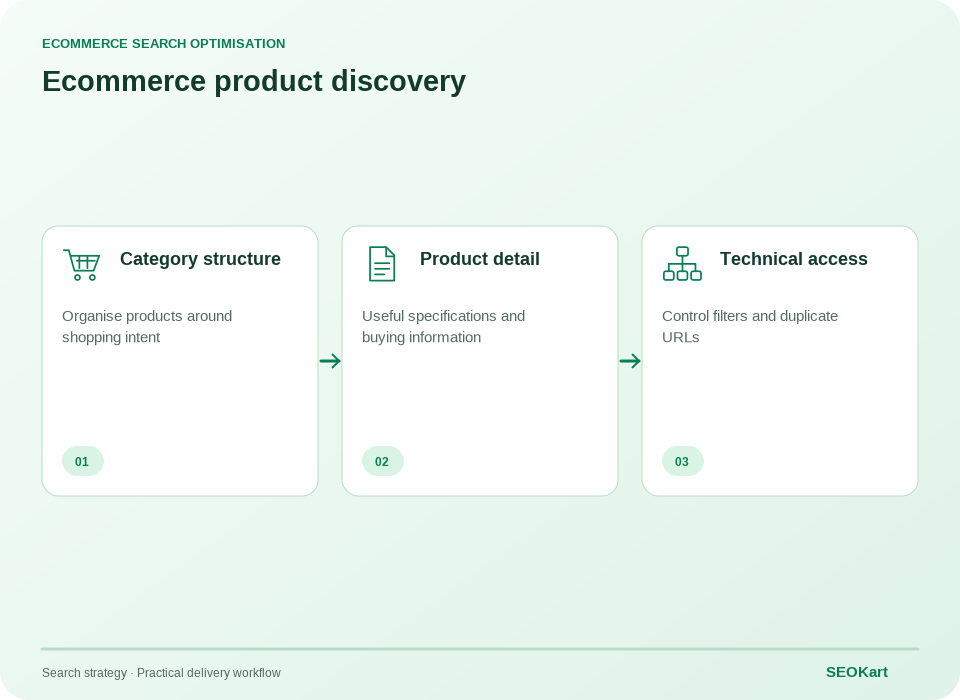
We distinguish pages that should attract organic shoppers from low-value combinations of filters, sort orders and product variants. The strategy includes category intent mapping, product information quality, canonical and indexation decisions, merchant-friendly structured data where appropriate, and measurement of organic product discovery and revenue.
Product and Category SEO for Online Stores Packages
Compare the scope of each package and choose a plan aligned with your goals. Contact us for a tailored proposal.
Starter
Focused Ecommerce SEO Campaign
- Technical crawl review up to 100 store URLs
- Optimise up to 10 product/category pages per month
- Up to 2 technical issue fixes/month within existing platform
- Product schema and indexation recommendations
- 1 category content briefs/month
- Monthly sales attribution review where tracking permits; custom development separate
Growth
Expanded Ecommerce SEO Campaign
- Technical crawl review up to 500 store URLs
- Optimise up to 20 product/category pages per month
- Up to 3 technical issue fixes/month within existing platform
- Product schema and indexation recommendations
- 2 category content briefs/month
- Monthly sales attribution review where tracking permits; custom development separate
Professional
Advanced Ecommerce SEO Campaign
- Technical crawl review up to 1500 store URLs
- Optimise up to 35 product/category pages per month
- Up to 5 technical issue fixes/month within existing platform
- Product schema and indexation recommendations
- 3 category content briefs/month
- Monthly sales attribution review where tracking permits; custom development separate
Enterprise
Comprehensive Ecommerce SEO Campaign
- Technical crawl review up to 5000 store URLs
- Optimise up to 50 product/category pages per month
- Up to 8 technical issue fixes/month within existing platform
- Product schema and indexation recommendations
- 4 category content briefs/month
- Monthly sales attribution review where tracking permits; custom development separate
Choosing the right package
Every online store has different requirements. The right SEO investment depends on factors such as catalogue size, number of categories, platform, technical complexity, competition, target market and business objectives.
SEOKart offers four levels of ecommerce SEO campaign scope, allowing businesses to select a programme that matches their current stage of growth.
For businesses targeting customers across India, our ecommerce organic growth packages focus on product and category architecture, transactional keywords and conversion-focused content. We assess your website, competitive landscape and growth priorities before recommending the right level of work. You can also explore our technical SEO fundamentals to understand how this work fits into a broader search strategy. The packages below are priced in Indian rupees for campaigns targeting India.
Billing currency: INR. Prices exclude 18% GST. Fixed monthly package fees for the stated scope. Deliverable limits are monthly maximums; initial setup uses the same agreed workload. Additional websites, languages, development and new long-form content are separately quoted. Service descriptions elsewhere on this page apply only within the selected plan scope.
For more detail, read our faceted navigation SEO guide, ecommerce SEO guide and internal linking guide.
SEOKart provides professional Ecommerce SEO Services designed to help online stores improve organic visibility, attract high-intent shoppers and generate more qualified organic traffic and sales.
Ecommerce SEO requires a different approach from standard business SEO. An online store can contain hundreds or thousands of product URLs, category pages, filters, variants and other dynamically generated pages. Search engines need to be able to crawl, understand and index the right pages while users need clear category structures, useful product information and a smooth buying journey.
Our ecommerce SEO campaigns combine technical SEO, ecommerce keyword research, category and product optimisation, structured data, internal linking, content strategy, competitor analysis, authority development and continuous performance optimisation.
We work with ecommerce businesses across India and international markets, including Shopify, WooCommerce and other ecommerce platforms.
Why Ecommerce SEO Requires a Specialised Strategy
An ecommerce website is fundamentally different from a typical service-business website. Online stores may contain hundreds or thousands of products spread across categories, subcategories, brands, filters and product variations, creating a much more complex search environment.
Successful ecommerce SEO requires deciding which pages should appear in Google, how products and categories should be organised, where commercial keywords should be targeted and how search engines can efficiently discover the most important pages.
For smaller stores, the priority may be establishing strong category and product optimisation. Larger ecommerce websites may require advanced management of crawlability, indexation, faceted navigation, duplicate URLs, product variants, internal linking and structured data.
SEOKart develops ecommerce SEO strategies around the size of your catalogue, ecommerce platform, competition, target market and customer search behaviour, rather than applying a standard SEO campaign to an online store.
What Our Ecommerce SEO Services Include
SEOKart provides comprehensive ecommerce SEO services covering the technical, structural, content and authority requirements of online stores. Our approach connects product and category optimisation with technical SEO, search intent, website architecture and content strategy so that each part of the store supports organic growth.
The exact work required depends on your ecommerce platform, catalogue size, existing search visibility and competition. Rather than applying the same checklist to every store, we prioritise the areas that can make the greatest difference to organic visibility, qualified traffic and online sales.
Ecommerce SEO Strategy
We begin by analysing your ecommerce website, catalogue, platform, competitors and target customers.
Our strategy considers:
Ecommerce SEO needs to make product categories, individual products and buying information discoverable without creating competing or duplicate URLs. The points below describe areas to evaluate according to the website and campaign scope.
- Catalogue Size
- Product Categories
- Search Demand
- Commercial Keywords
- Search Intent
- Competition
- Website Architecture
- Technical SEO
- Content Opportunities
- Authority Development
- Conversion Opportunities
The objective is to create an SEO roadmap based on the actual structure and requirements of your online store.
Ecommerce Keyword Research
Ecommerce keyword research focuses heavily on buying intent and the relationship between searches, categories and products.
Research can identify:
- Product Keywords
- Category Keywords
- Commercial Keywords
- Transactional Keywords
- Long-Tail Searches
- Brand Searches
- Product Attribute Searches
- Comparison Searches
- Problem-Based Searches
- Informational Searches
Keywords are mapped to the appropriate product, category or content page rather than targeting every term on the same page.
Product Page SEO
Product pages are central to ecommerce organic search visibility.
Optimisation can include:
- Product Titles
- Meta Descriptions
- Product Descriptions
- Product Attributes
- Heading Structure
- Internal Links
- Image SEO
- Product Schema
- Review Information
- Search Intent Alignment
- Related Product Links
Where large catalogues are involved, templates and scalable optimisation strategies may be required.
For stores selling products also available through other retailers, product pages should provide more value than standard manufacturer-supplied information. Useful specifications, unique product details, buying information, FAQs, images, comparisons and relevant internal links can help create stronger product pages for both shoppers and search engines. For large catalogues, we identify where unique optimisation can have the greatest commercial impact rather than simply adding unnecessary text to every product page.
Category Page SEO
Category pages can target broader commercial searches and provide an important bridge between search engines, products and shoppers.
Our category optimisation can address:
- Category Titles
- Category Descriptions
- Search Intent
- Internal Linking
- Subcategory Structure
- Product Organisation
- Content Opportunities
- Category Schema Where Appropriate
- User Experience
- Conversion Elements
Category pages can be especially valuable for shoppers who know the type of product they want but have not yet selected a specific model or item. These searches often have strong commercial intent, making well-optimised category and subcategory pages important organic landing pages. We structure category content to provide useful context without overwhelming shoppers, while ensuring products, subcategories, filters and internal links help users move naturally towards the products most relevant to their requirements.
Ecommerce Technical SEO
Technical SEO becomes particularly important as ecommerce websites grow.
Our technical work can address:
- Crawlability
- Indexation
- Canonicalisation
- XML Sitemaps
- Robots.txt
- Duplicate URLs
- Product Variants
- Pagination
- Faceted Navigation
- Parameter URLs
- Redirects
- Broken Links
- Website Architecture
- Mobile SEO
- Core Web Vitals
- Structured Data
On large ecommerce websites, technical SEO is also about helping search engines spend their crawling resources on pages that can provide genuine search value. Product filters, sorting options, tracking parameters, internal search results and product variations can generate large numbers of URLs without creating meaningful new landing pages. We analyse these patterns to help search engines concentrate on important products, categories and content while maintaining a website structure that remains useful for shoppers.
Faceted Navigation SEO
Filters can create a very large number of URLs on ecommerce websites.
For example, a store may allow users to filter products by:
Brand | Size | Colour | Price | Material | Rating | Availability
Without appropriate controls, these combinations can create unnecessary URLs and duplicate or low-value pages.
Our ecommerce SEO strategy can determine which filtered pages should be:
- Crawled
- Indexed
- Canonicalised
- Blocked
- Consolidated
- Used as intentional landing page
Not every filtered URL should automatically be removed from search. Some combinations can represent genuine customer demand—for example, shoppers searching by brand, product type, material, size or another commercially important attribute. Where sufficient search demand and suitable products exist, selected filter combinations may be developed into useful indexable landing pages. The objective is to distinguish valuable search destinations from the potentially thousands of low-value URL combinations an ecommerce filtering system can generate.
This is important because it shows that SEOKart isn't simply applying
Product Schema and Structured Data
Structured data helps search engines understand important ecommerce information.
Depending on the website, this can include:
- Product Schema
- Offer Information
- Price
- Availability
- Review Information
- Aggregate Rating
- Breadcrumb Schema
- Organisation Information
Implementation depends on the platform and the information actually available on the website.
Ecommerce structured data should accurately reflect the information available to shoppers on the page. Product prices, availability, reviews and other structured information need to remain consistent with the current product data, particularly on stores where prices or stock levels change frequently. We review structured data as part of the wider ecommerce SEO setup so that it supports search engines in understanding products without introducing conflicting or unsupported information.
Internal Linking
A strong internal linking structure helps search engines understand relationships between products, categories and supporting content.
Our strategy can connect:
Blog Content → Category Pages → Subcategories → Product Pages
This can strengthen topical relationships and help users discover relevant products.
Internal linking can also help distribute authority towards commercially important categories and products that may otherwise sit several levels deep within a large ecommerce website. Navigation, breadcrumbs, category relationships, related products and contextual links can all contribute to a clearer site structure when implemented appropriately.
We identify priority pages based on search opportunity and commercial importance, then look for relevant ways to connect them with supporting categories, products and content. The objective is not to create excessive internal links, but to build logical pathways that help shoppers navigate the store while making important page relationships clearer to search engines.
Ecommerce Content Strategy
Content can help ecommerce websites capture searches before users reach the final buying stage.
Content opportunities can include:
- Buying Guides
- Product Comparisons
- Product Reviews
- How-To Guides
- Best Product Articles
- Product Education
- FAQs
- Category Guides
- Industry Resources
Content is developed around relevant search intent rather than publishing large volumes of unrelated articles.
Ecommerce content should ultimately support the store's commercial pages rather than exist as a separate blog strategy. Informational content can answer questions customers have before purchasing, explain differences between products and help shoppers identify which product or category best matches their requirements.
Where relevant, supporting content can internally link to appropriate categories and products, helping potential customers move from research towards purchase while strengthening the topical relationships between informational and commercial pages. We prioritise subjects that are genuinely connected with the products the business sells and the questions its customers ask.
Ecommerce Link Building
Competitive ecommerce markets can require authority development in addition to technical and on-page SEO.
Our strategies can focus on:
- Relevant Editorial Links
- Industry Publications
- Product Resources
- Digital PR Opportunities
- Supplier & Partner Relationships
- Relevant Content Outreach
The objective is to build relevant authority rather than relying on bulk low-quality links.
Ecommerce businesses can have natural authority-building opportunities that are different from those available to conventional service websites. Brands, manufacturers, suppliers, distributors, industry organisations, specialist publications and useful product resources can all create relevant opportunities depending on the store and its market.
We focus authority-building efforts on opportunities that make sense for the business and can support important product categories, commercial content and overall domain authority. The aim is to strengthen the store's ability to compete in relevant search markets rather than pursuing links simply to increase backlink counts.
Ecommerce Competitor Analysis
We analyse competing ecommerce websites to identify opportunities around:
- Product Keywords
- Category Keywords
- Content
- Search Visibility
- Website Architecture
- Internal Linking
- Structured Data
- Authority
- Commercial Search Intent
- Content Gaps
These findings help shape the broader SEO campaign.
Ecommerce search competitors are not always the same businesses you consider your main commercial competitors. Different retailers, marketplaces, manufacturers and specialist stores may compete with individual categories or products across different search results.
We therefore analyse competition at the keyword, category and product level rather than relying only on a small list of competing brands. This can reveal categories where competitors have stronger coverage, commercially valuable searches they have overlooked and areas where your store can build more useful content, stronger page structures or greater topical depth.
Shopify Ecommerce SEO
Shopify provides a strong platform for online stores, but effective organic growth requires more than adding products and completing basic metadata.
SEOKart provides Shopify SEO services focused on helping stores improve the visibility of their products, collections and supporting content while maintaining a search-friendly website structure.
Our Shopify ecommerce SEO strategy can address:
- Product page optimisation
- Collection page optimisation
- Keyword targeting and search intent
- Shopify site structure
- Internal linking
- Titles and meta descriptions
- Product and structured data
- Image optimisation
- Crawlability and indexation
- Duplicate and unnecessary URLs
- Collection organisation
- Content strategy
- Technical SEO
- Conversion-focused search optimisation
The exact implementation depends on the Shopify theme, apps, catalogue structure and existing configuration.
For larger Shopify stores, we also examine how collections, tags, product variants, filters and other platform-generated URLs affect crawling and indexation. The objective is to help search engines concentrate on commercially important pages while maintaining a straightforward shopping experience for customers.
WooCommerce SEO for WordPress Online Stores
WooCommerce gives businesses considerable flexibility over products, categories, content and website architecture, but that flexibility can also create technical SEO challenges when a store grows.
Our WooCommerce SEO services can cover:
- Product page SEO
- Product category optimisation
- Product attributes and variations
- Keyword research
- Titles and metadata
- WooCommerce structured data
- Internal linking
- Crawlability and indexation
- Duplicate URL management
- Product variants
- Technical SEO
- Ecommerce content strategy
- Website architecture
- Performance and Core Web Vitals
Because WooCommerce operates within WordPress, SEO performance can also be influenced by themes, plugins, URL structures and the way products, categories and attributes have been configured.
We analyse the store as a complete website rather than treating WooCommerce product pages as isolated URLs.
Ecommerce SEO Services for Businesses Across India
SEOKart provides ecommerce SEO services in India for online stores targeting local, regional and nationwide customers.
An ecommerce business does not necessarily need separate SEO strategies for every city where customers live. For stores delivering products throughout India, product and category search demand is generally more important than repeatedly targeting geographic keywords.
Depending on the business model, we can develop ecommerce SEO campaigns for companies operating from or targeting customers across Delhi, Mumbai, Bangalore, Hyderabad, Chennai, Pune, Ahmedabad, Jaipur, Kolkata, Gurgaon, Noida, Chandigarh, Lucknow, Indore, Surat, Nagpur, Kochi, Coimbatore and other Indian markets.
For businesses with physical stores, service areas or genuine location-specific offerings, geographic SEO can be incorporated where it provides meaningful value.
The strategy is determined by how customers actually purchase from the business, rather than automatically creating location pages for every city.
National Ecommerce SEO for Online Stores Selling Across India
Online stores capable of delivering throughout India can compete for customers far beyond their physical business location.
National ecommerce SEO can focus on product categories, subcategories, brands, product types, attributes and individual products that customers search for regardless of city.
For example, a store based in Delhi, Pune or Bangalore may generate organic sales from customers throughout the country without needing to rank for phrases containing those city names.
Our national ecommerce SEO approach can combine category optimisation, product SEO, technical improvements, content strategy, internal linking and authority development to strengthen visibility across commercially relevant Indian searches.
Ecommerce SEO Reporting Focused on Meaningful Performance
Rankings are useful indicators, but an ecommerce SEO campaign should ultimately contribute to meaningful business performance.
Our reporting can therefore extend beyond keyword positions to show how organic search contributes to product discovery, category visibility, traffic and ecommerce activity.
Depending on the campaign and available tracking, reporting can include:
- Organic traffic
- Organic revenue where tracking is available
- Ecommerce conversions
- Keyword visibility
- Product rankings
- Category rankings
- Google Search Console performance
- Organic clicks and impressions
- Indexed products
- Indexed categories
- Technical SEO issues
- Top-performing products
- Top-performing categories
- Competitor visibility
- SEO recommendations
Different ecommerce businesses can require different performance indicators.
A store with thousands of products may place considerable importance on category visibility and organic revenue, while a smaller specialist retailer may focus on a limited number of high-value products and commercial keywords.
Reporting should therefore remain connected with the actual objectives of the campaign.
Ecommerce SEO and Conversion-Focused Optimisation
Generating more organic traffic is valuable only when shoppers can find the right products and move successfully through the purchasing journey.
SEO and user experience are therefore closely connected on ecommerce websites.
Our ecommerce campaigns can identify opportunities involving:
- Product page experience
- Category page structure
- Calls to action
- Mobile experience
- Trust signals
- Product information
- Navigation
- Internal linking
- Search-intent alignment
For example, ranking a category page for an important commercial search provides limited value if customers cannot easily understand the products, compare their options or navigate towards an appropriate purchase.
We therefore consider the experience users receive after arriving from organic search alongside the search visibility of the page itself.
Where more extensive conversion rate optimisation is required, it can be incorporated into a customised ecommerce growth programme.
Managing Out-of-Stock and Discontinued Products for SEO
Product availability constantly changes on ecommerce websites.
Products can temporarily go out of stock, be permanently discontinued or be replaced by newer models. Automatically deleting these pages can sometimes remove useful search visibility, backlinks and customer information.
The appropriate treatment depends on the situation.
Temporarily unavailable products may remain useful when they are expected to return. Permanently discontinued products may sometimes require a relevant replacement, category destination or other appropriate treatment.
The objective is to preserve useful search value where possible while avoiding large numbers of obsolete or unhelpful product pages.
For stores with frequently changing inventories, product lifecycle management should therefore form part of the wider technical SEO strategy.
Ecommerce SEO for Product Variants
Products frequently have variations based on colour, size, material, capacity, model or other attributes.
Depending on how the ecommerce platform handles these variations, a single product can potentially generate several URLs containing substantially similar information.
Our ecommerce SEO strategy examines whether variants should remain part of a primary product page or whether particular variations represent sufficiently distinct search demand to justify their own landing pages.
The correct approach depends on the products, platform, search behaviour and technical implementation.
This helps prevent unnecessary duplication while retaining valuable product-specific search opportunities.
Mobile Ecommerce SEO
Many customers discover, compare and purchase products from mobile devices, making the mobile shopping experience an important part of ecommerce SEO.
Mobile optimisation involves more than simply ensuring that a website fits a smaller screen.
Product images, navigation, filters, category structures, product information and calls to action should remain easy to use without creating unnecessary technical or performance problems.
We can evaluate mobile usability alongside technical SEO and Core Web Vitals to identify issues that may affect both organic visibility and the customer journey.
Ecommerce Site Architecture That Can Grow with Your Catalogue
Website architecture becomes increasingly important as an ecommerce catalogue expands.
A straightforward store might contain:
Homepage → Categories → Products
A larger website may require:
Homepage → Main Categories → Subcategories → Products
Additional brand, attribute or use-case pages may also be appropriate where genuine customer demand exists.
The objective is to maintain a logical structure in which important commercial pages can be reached without becoming buried unnecessarily deep within the website.
Clear architecture also supports internal linking, breadcrumb navigation and the relationship between categories and products.
SEO for Large Ecommerce Catalogues
Stores containing hundreds or thousands of products cannot always be optimised effectively by treating every URL manually.
Large catalogues require prioritisation and scalable processes.
We can identify commercially important categories and products according to search demand, existing performance, competition and business priorities.
Templates, structured information and scalable optimisation approaches can then support larger portions of the catalogue while allowing high-value pages to receive more detailed attention.
This helps direct SEO resources towards areas where they can produce greater commercial value.
Ecommerce SEO Results and Timelines
Ecommerce SEO is an ongoing process, and there is no single timeframe applicable to every online store.
Progress can be influenced by:
- Catalogue size
- Existing organic visibility
- Technical condition
- Website architecture
- Competition
- Domain authority
- Content quality
- Product and category optimisation
- Implementation speed
- Target markets
A smaller store with a focused catalogue and relatively straightforward technical setup can require considerably less work than an established ecommerce website containing thousands of products, filters and variants.
Newly optimised pages also need to be crawled, processed and evaluated by search engines, while competitive categories can require sustained improvements in content, technical quality and authority.
SEOKart does not guarantee specific Google rankings. Search results are controlled by search engines and can be influenced by numerous factors outside the direct control of an SEO agency.
Our focus is on improving the factors we can influence: technical accessibility, relevance, website structure, content quality, internal linking, authority and overall organic search strategy.
Why Choose SEOKart for Ecommerce SEO?
Ecommerce SEO requires a combination of technical knowledge, commercial understanding and scalable optimisation.
SEOKart approaches an online store as an interconnected search ecosystem rather than a collection of individual product pages.
Our campaigns can bring together:
Technical SEO to help search engines efficiently access important pages.
Product and category optimisation to improve visibility for commercial searches.
Keyword research to identify how potential customers search for products.
Website architecture and internal linking to strengthen relationships between important pages.
Content strategy to reach customers throughout their buying journey.
Structured data to help search engines understand ecommerce information.
Authority development to strengthen competitiveness in difficult markets.
AI SEO to improve content clarity and visibility as search experiences continue to evolve.
Most importantly, the campaign is structured around the actual store rather than forcing every ecommerce business into an identical SEO template.
Ecommerce SEO for Small Stores, Growing Brands and Enterprise Websites
The requirements of a small specialist online store are fundamentally different from those of a national ecommerce brand containing tens of thousands of URLs.
A smaller store may initially need to establish strong technical foundations, optimise its most important categories and improve individual product pages.
A growing ecommerce company may need broader category coverage, content development, stronger internal linking and authority building.
Large ecommerce businesses may require extensive crawl and indexation management, scalable product optimisation, advanced website architecture and multi-market strategies.
Our four ecommerce SEO campaign levels allow the scope of work to increase alongside the complexity and competitive requirements of the store.
Grow Your Ecommerce Business with Strategic SEO
Successful ecommerce SEO requires much more than adding keywords to product titles.
Search engines need to understand which products and categories matter, how pages relate to one another and which URLs deserve to appear in search. At the same time, shoppers need useful product information, logical navigation and a straightforward path from search to purchase.
SEOKart combines technical ecommerce SEO, keyword research, product optimisation, category SEO, structured data, internal linking, content strategy, competitor analysis, authority development and AI SEO to build stronger organic visibility around your products and customers.
Whether you operate a small Shopify store, a growing WooCommerce business, an established ecommerce brand, a large product catalogue or an international online store, your campaign can be structured around your platform, catalogue, competition and growth objectives.
Ready to grow your ecommerce business through organic search? Choose the ecommerce SEO package that matches your requirements or contact SEOKart for a customised ecommerce SEO strategy.