Small businesses across India face very different search markets. A service keyword in Mumbai may attract national chains and established agencies, while the same service in a smaller city may be shaped by local trust, regional language and word of mouth. The opportunity comes from understanding demand in each market—not assuming smaller cities are automatically easy to rank in.
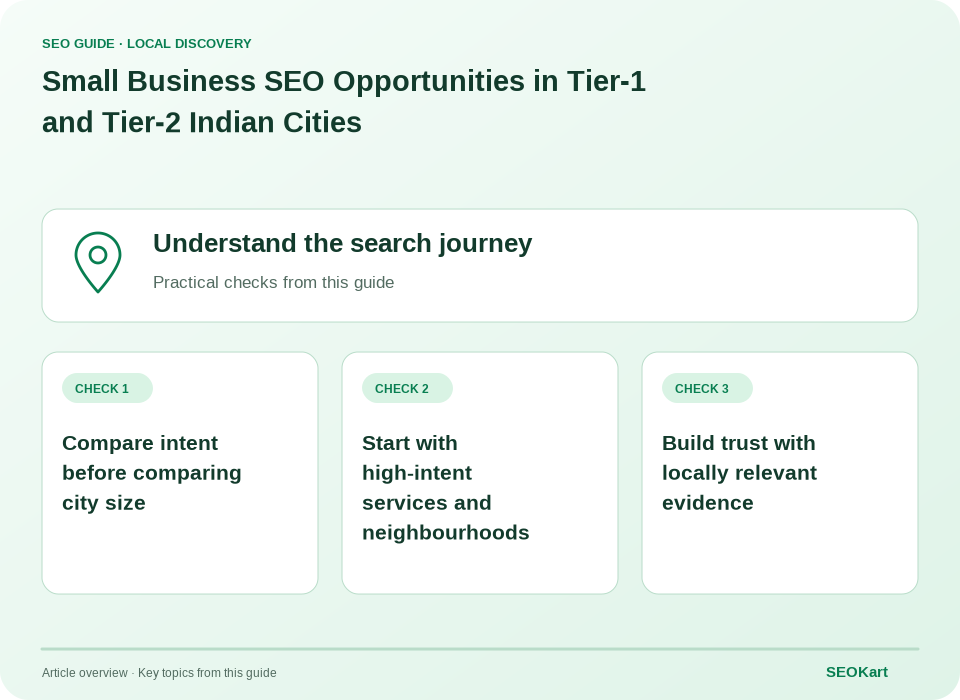
Compare intent before comparing city size
Tier-1 and Tier-2 labels are useful shorthand, but search intent matters more. In a metro, a customer might compare several specialist providers and expect detailed service information. In a growing city, the same customer may prioritise service availability, response time, location and reputation. Inspect actual search results and customer enquiries before selecting pages to create.
Start with high-intent services and neighbourhoods
List your most profitable services, then identify the queries customers use when ready to contact a provider. Combine service pages with genuinely useful location information where appropriate. A home services business may need coverage, appointment and emergency details; a B2B supplier may need specifications, minimum orders and delivery areas.
Build trust with locally relevant evidence
Use accurate contact details, photos of real work, customer examples and transparent service boundaries. In highly competitive markets, detailed case studies and specialist expertise may differentiate you. In smaller markets, clear answers about availability, language support and after-sales service can remove important barriers to enquiry.
Consider regional language without copying pages
Some audiences search in English, Hindi or regional languages. Create translated or localised pages only when you can maintain accurate, natural content and support the enquiries they generate. Do not publish automatic translations that misstate services. If language variants exist, review internal links, canonical choices and hreflang implementation where relevant.
Connect Maps, organic pages and conversion paths
For eligible businesses, maintain a complete Google Business Profile and consistent contact information. On the website, keep important services easy to find and forms easy to use on mobile. Calls and WhatsApp enquiries can matter as much as online form submissions, but record their sources where feasible.
Measure market-by-market and expand deliberately
Group Search Console and lead data by service and city. Watch qualified enquiries, close rates and delivery costs—not just traffic. A smaller city with fewer searches may deliver profitable customers, while a metro may justify higher investment for a valuable niche. Expand only when the existing pages demonstrate usefulness and results. For more detail on this related topic, see Local SEO Opportunities Across 10 Indian Cities.
Related SEOKart guides
Explore SEO in Indian metro markets, local SEO in growing cities, small business SEO planning for the next steps.
Is SEO easier in Tier-2 cities?
Not necessarily. Competition varies by industry and query; some smaller markets have strong incumbents or limited search demand.
Should I create separate pages for every Indian city?
No. Create city pages only for places you serve and where you can provide meaningful, distinctive information.
Will regional-language pages improve rankings?
They can help when users search in that language and the content is accurate, useful and properly maintained; translation alone is not a ranking guarantee.
What is the best first SEO investment for a small business?
Improve core service pages, technical accessibility, genuine business information and lead tracking before expanding into many locations.