Google Maps visibility matters when customers search for a business close to them or in a specific area. However, no agency can guarantee a top-three Maps placement. Google's local results are influenced by relevance, distance and prominence, and the same business can appear in different positions for different searchers.
Relevance
Google needs to understand whether your business matches the service a person is looking for. Accurate categories, services, website content and profile details all help communicate what you actually offer.
Distance
The distance between the searcher or named search location and a business affects local results. You cannot solve a distance disadvantage by stuffing city names into descriptions or creating fictional office listings.
Prominence
Prominence relates to how well known and established a business is, including signals such as genuine reviews and information found elsewhere on the web. It cannot be manufactured reliably through bulk directory spam.
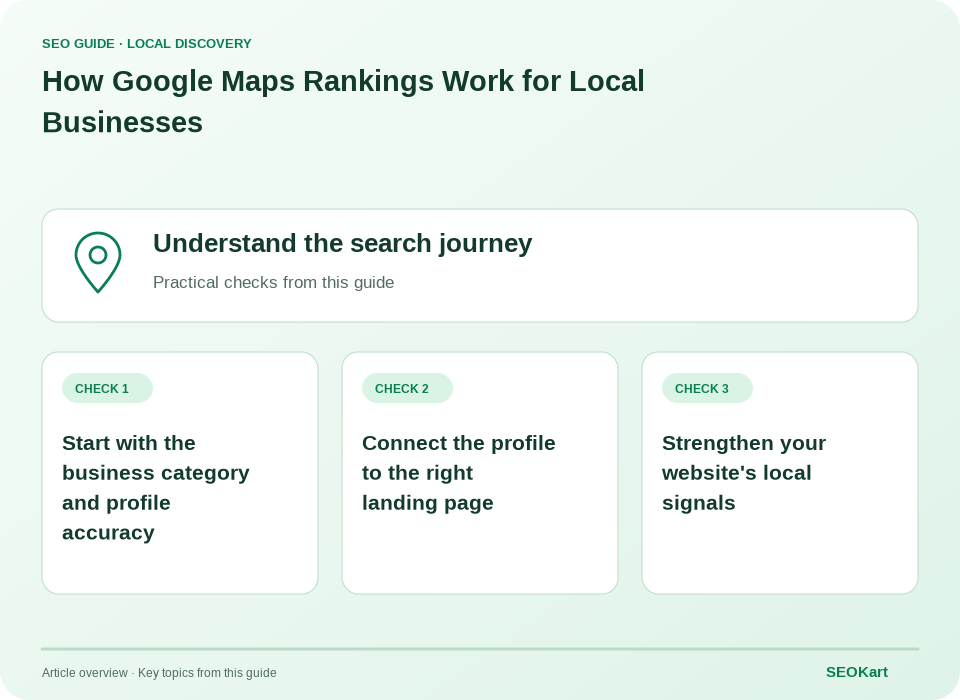
Start with the business category and profile accuracy
Review your primary category first. It should describe your principal service, not simply the category with the largest search volume. Add relevant services, accurate hours, a working contact number and your real website. Verify your map pin and address or service area.
Connect the profile to the right landing page
Send visitors to a page that answers the query behind the listing. A plumbing service should explain emergency availability, coverage and how to request help. A professional services company should explain its expertise, scope, process and enquiry options. The homepage is not automatically the best destination for every service. For more detail on this related topic, see Google Map Pack Explained: Local Rankings, Visibility and Leads.
Strengthen your website's local signals
- Publish original, useful service descriptions with clear contact information.
- Keep location information consistent with the business's actual operations.
- Improve mobile usability and test click-to-call and form submissions.
- Link naturally between relevant service and location pages.
- Use relevant structured data accurately, without inventing ratings or addresses.
See the local SEO checklist for an implementation sequence.
Develop a sustainable review process
Request reviews from actual customers and respond to them. A healthy review profile reflects real experiences, not an artificial target count. Avoid review gating, purchased reviews and misleading claims. Review quality and customer experience matter more than gaming a star average.
Measure Maps performance correctly
Rank-checking from one device or one location gives a narrow picture. Search results vary by location and context. Use Google Business Profile performance to understand profile interactions and pair that with website enquiry tracking. Monitor whether visibility brings relevant calls, directions requests and qualified leads.
Common mistakes that waste effort
- Adding keywords to the business name that are not part of the real name.
- Using virtual offices or fake addresses to target distant cities.
- Creating duplicate profiles for the same eligible business location.
- Buying reviews or posting fabricated testimonials.
- Assuming that adding more keywords to a profile guarantees higher rankings.
A practical 30-day improvement plan
Week 1: Verify profile eligibility, categories and contact details. Week 2: Improve the linked service page and fix mobile enquiry friction. Week 3: Correct important listings and introduce a compliant review request process. Week 4: Review profile interactions, website enquiries and next priorities. This is a work plan, not a promised ranking deadline.
Need a local visibility strategy?
SEOKart can review your profile, local pages and enquiry journey together. Learn about our local SEO campaigns or contact our team for a tailored assessment.