Plan an SEO budget around competition, technical needs, content priorities and lead goals rather than arbitrary keyword counts.
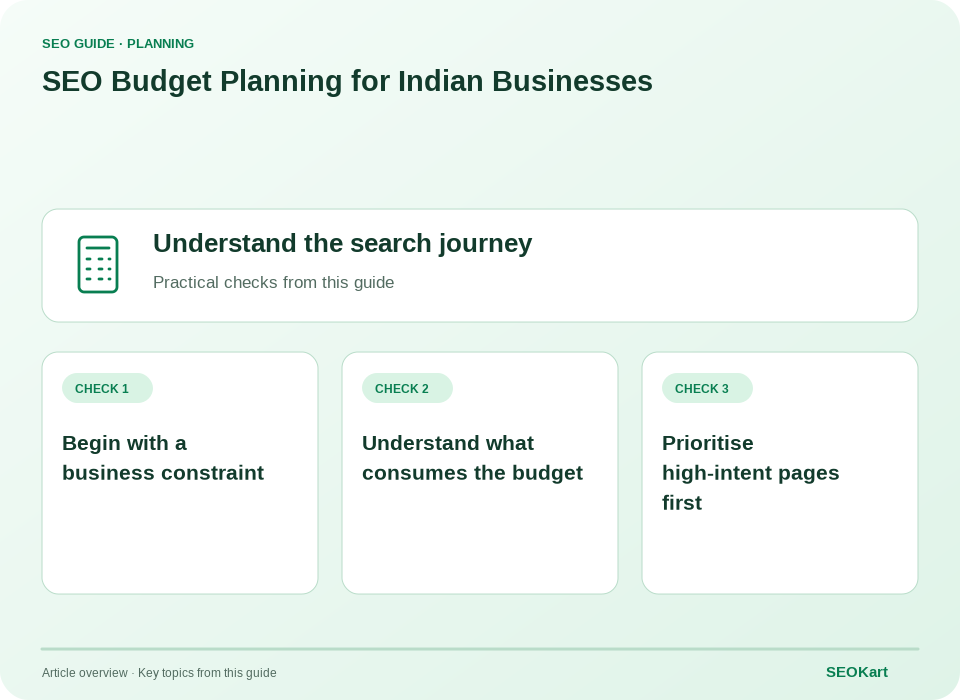
Begin with a business constraint
Decide how much the business can invest consistently without relying on immediate organic returns. Estimate the value of a qualified customer, the sales cycle and the number of opportunities needed to make SEO commercially worthwhile. A budget that cannot fund implementation is unlikely to deliver much value.
Understand what consumes the budget
Typical work includes research, technical fixes, content updates, commercial landing pages, internal linking, local profile improvements and measurement. Some tasks are one-time investments; others require continuous review. Website development and photography may sit outside an agency retainer, so confirm what is included. For more detail on this related topic, see SEO Strategy for Indian Businesses: A Practical Roadmap.
Prioritise high-intent pages first
For many Indian service businesses, the strongest starting point is a clear homepage, service pages, relevant location pages and a trustworthy contact experience. Fix indexability and speed problems that prevent those pages from working before scaling blog production. Avoid creating dozens of near-identical city pages simply to increase page count.
Match investment to market difficulty
A single-location business competing in a narrow category has different needs from a company targeting Delhi, Mumbai and Bengaluru simultaneously. National ecommerce and highly competitive B2B categories usually require broader technical and editorial scope. Ask for a proposal that identifies the actual work behind each fee. For more detail on this related topic, see Small Business SEO in India: A Practical Growth Plan.
Plan for review and reallocation
Set milestones for implementation, visibility, qualified enquiries and conversion quality. Review results periodically, then redirect effort toward pages and services with the strongest opportunity. Resist contracts based only on fixed article or backlink quotas.
Compare transparent scopes
A practical proposal should name target pages, deliverables, owners, review cadence and exclusions. Explore SEOKart SEO services and use an SEO audit to establish priorities before committing to a longer engagement. For more detail on this related topic, see Monthly SEO vs One-Time SEO: What Are You Paying For?.