
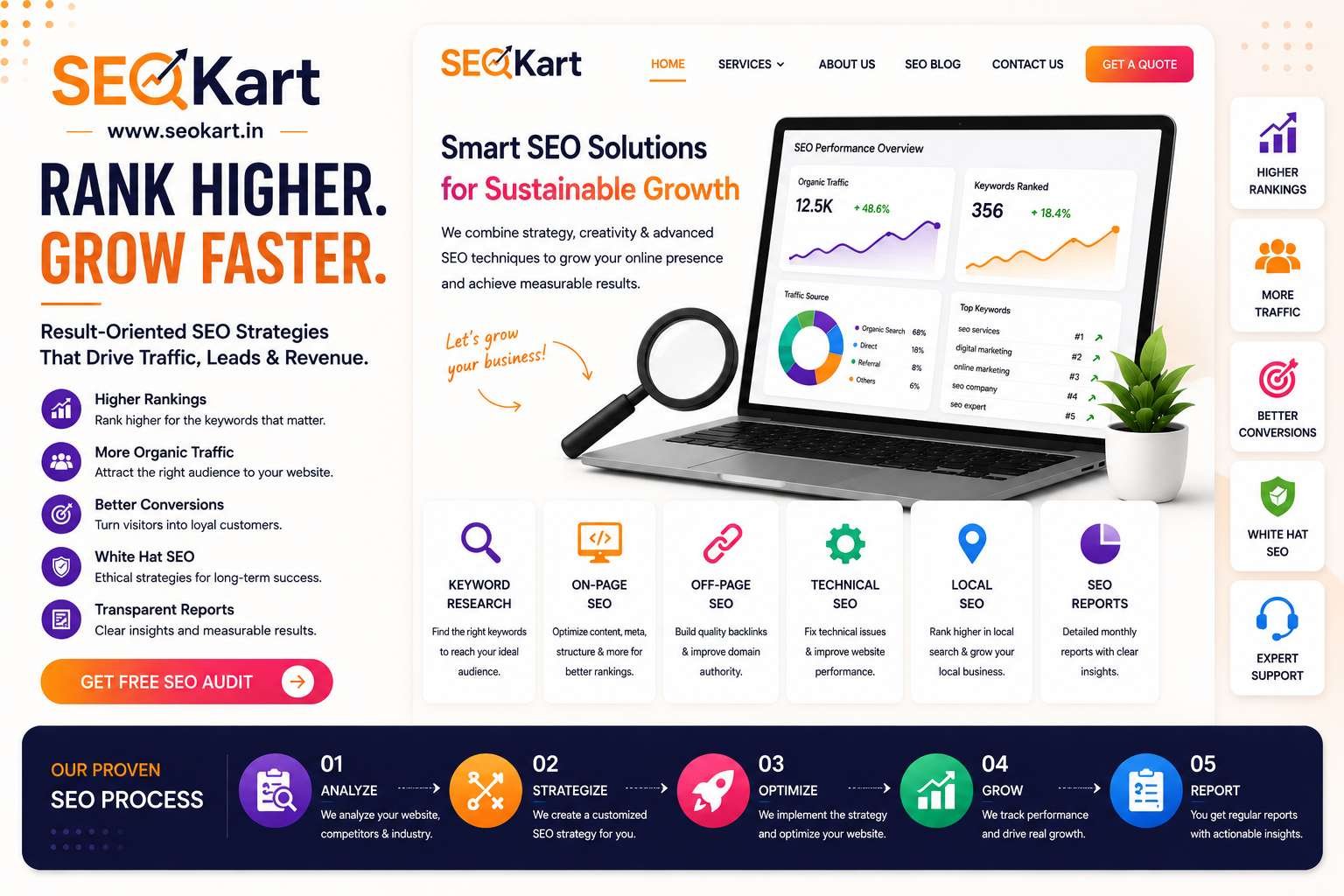
Many businesses invest in websites, social media marketing, and online advertising, yet fail to develop a proper SEO strategy.
Without a clear SEO plan, even the best-looking website can struggle to attract visitors, generate leads, and compete in search results.
As online competition continues to grow in 2026, businesses that rely solely on referrals, social media, or paid advertising risk missing valuable opportunities.
A well-defined SEO strategy helps businesses increase visibility, attract qualified traffic, and create a sustainable source of leads and customers.
What Is an SEO Strategy?
An SEO strategy is a structured plan designed to improve a website's visibility in search engines.
Rather than focusing on isolated tasks, an SEO strategy combines multiple activities into a coordinated approach.
A typical SEO strategy includes:
- Keyword research
- Content planning
- Technical optimization
- On-page SEO
- Link building
- Local SEO
- Performance tracking
The goal is to increase organic traffic while improving user experience and business results.
Why SEO Is More Important Than Ever
Consumers increasingly rely on search engines to find information, products, and services.
Before making a purchase or hiring a service provider, many people search online for:
- Reviews
- Comparisons
- Solutions
- Service providers
- Industry information
Businesses that appear prominently in search results gain a significant advantage over competitors that are difficult to find online.
SEO Helps Customers Find Your Business
No matter how good your products or services are, customers cannot contact you if they cannot find you.
An SEO strategy helps your business appear when potential customers search for relevant keywords.
Examples include:
- SEO Services for Small Businesses
- Website Design Company Near Me
- Best Web Hosting Provider
- Local Digital Marketing Agency
Improved visibility leads to more opportunities for inquiries and sales.
SEO Generates High-Quality Traffic
One of the biggest advantages of SEO is that it targets users who are actively searching for solutions.
Unlike traditional advertising, SEO reaches people who already have interest in your products or services.
This often results in:
- Better lead quality
- Higher conversion rates
- Improved return on investment
Targeted traffic is typically more valuable than large amounts of untargeted visitors.
SEO Supports Long-Term Growth
Paid advertising can generate immediate traffic, but results often stop when advertising budgets are paused.
SEO works differently.
A strong SEO strategy creates long-term assets such as:
- Optimized service pages
- Valuable blog content
- Quality backlinks
- Strong website authority
These assets continue generating value long after they are created.
SEO Builds Trust and Credibility
Consumers often associate high search rankings with credibility.
When your website consistently appears in search results, users are more likely to view your business as trustworthy and professional.
Trust is particularly important for service-based businesses where customers carefully evaluate providers before making decisions.
SEO Improves User Experience
Modern SEO focuses heavily on user experience.
Optimization efforts often include:
- Faster page loading times
- Mobile responsiveness
- Better website structure
- Improved navigation
- Helpful content
These improvements benefit both search engines and website visitors.
SEO Helps You Compete More Effectively
Regardless of your industry, competitors are likely investing in digital marketing.
Businesses without an SEO strategy may gradually lose visibility and market share.
An effective SEO strategy helps level the playing field and allows smaller businesses to compete with larger organizations.
Local SEO Creates Additional Opportunities
For businesses serving specific locations, local SEO is essential.
Local SEO helps businesses appear in:
- Google Maps
- Local search results
- "Near Me" searches
Examples include:
- SEO Company in Delhi
- Web Designer in Chandigarh
- Website Developer Near Me
Strong local visibility can drive highly qualified leads and customer inquiries.
SEO Provides Measurable Results
Unlike some traditional marketing methods, SEO performance can be measured accurately.
Businesses can track:
- Website traffic
- Keyword rankings
- User behavior
- Lead generation
- Conversion rates
These insights help refine strategies and improve performance over time.
What Happens Without an SEO Strategy?
Businesses that ignore SEO often face challenges such as:
- Low website traffic
- Poor visibility
- Reduced lead generation
- Dependence on paid advertising
- Difficulty competing online
Without a strategy, SEO efforts often become inconsistent and ineffective.
Key Elements of a Successful SEO Strategy
A strong SEO strategy typically includes:
Keyword Research
Understanding what customers search for online.
Content Creation
Publishing valuable and relevant content consistently.
Technical SEO
Ensuring websites are fast, secure, and crawlable.
Link Building
Building authority through quality backlinks.
Local SEO
Optimizing visibility within specific geographic areas.
Ongoing Monitoring
Tracking performance and making data-driven improvements.
How Long Does an SEO Strategy Take to Work?
SEO is a long-term investment.
Most businesses begin seeing measurable improvements within three to six months.
More significant growth often occurs between six and twelve months of consistent effort.
Patience and consistency are essential for achieving strong results.
Conclusion
In 2026, having a website is no longer enough.
Businesses need a clear SEO strategy to attract customers, compete effectively, and achieve sustainable growth online.
A successful SEO strategy helps improve visibility, increase traffic, generate leads, and strengthen brand credibility over time.
Businesses that invest in SEO today will be better positioned to succeed in an increasingly competitive digital environment.
Frequently Asked Questions
What is an SEO strategy?
An SEO strategy is a structured plan for improving a website's visibility in search engines and attracting more organic traffic.
Why is SEO important for businesses?
SEO helps businesses increase visibility, generate leads, and attract customers who are actively searching online.
How long does an SEO strategy take to produce results?
Most businesses begin seeing measurable improvements within three to six months.
Can small businesses benefit from SEO?
Yes. SEO allows small businesses to compete effectively and attract targeted traffic without relying entirely on paid advertising.
Is SEO a one-time project?
No. SEO requires ongoing optimization, content creation, and monitoring to maintain and improve results.