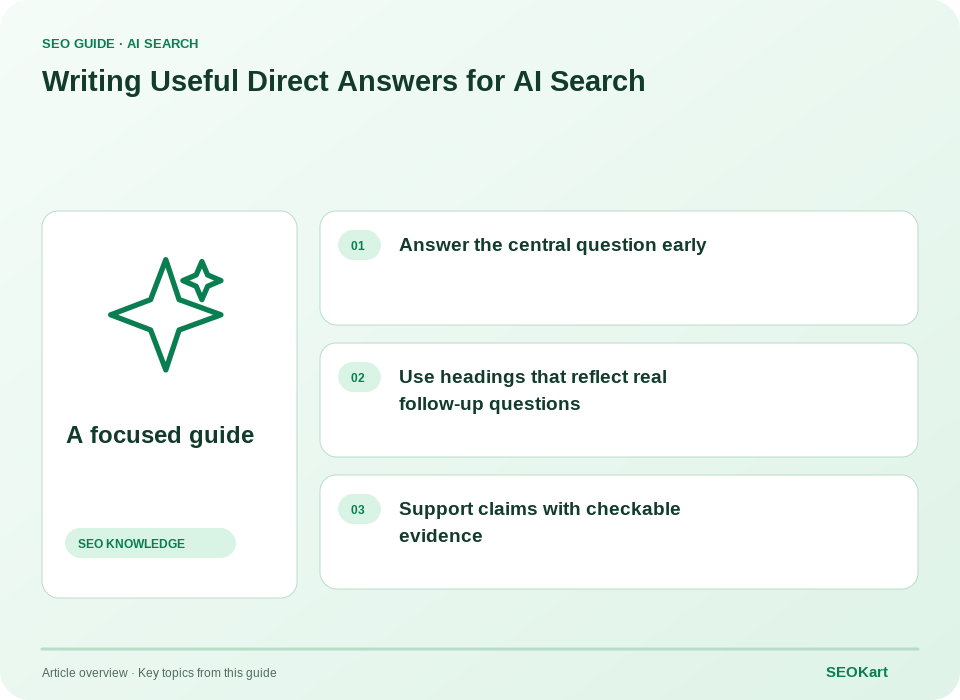
Structure accurate, specific answers for AI-assisted search while keeping articles useful and substantial.
Answer the central question early
Readers should not have to scroll through promotional introductions to understand the main answer. Begin with a clear explanation of the topic and the circumstances that change the answer. Follow with detail, examples and limitations rather than repeating the same sentence in several formats.
Use headings that reflect real follow-up questions
Organise sections around decisions people make: what something means, when it applies, how to implement it, what can go wrong and how to verify results. Question-style headings can help when they sound natural, but there is no need to turn every heading into a question.
Support claims with checkable evidence
Use accurate definitions, first-hand observations, relevant examples and links to authoritative sources where appropriate. Identify assumptions and dates for time-sensitive information. Avoid fabricated statistics, unsupported promises or claims that an AI system will cite a page simply because it follows a formatting template. For more detail on this related topic, see SEO Heading Structure: How to Use H1, H2 and H3.
Keep entities and relationships explicit
State who or what an answer concerns, which product or process is involved and how related concepts differ. Replace vague phrases such as “this method” with the actual term when clarity matters. The AI SEO guide for Indian businesses provides broader planning context.
Add depth beyond a short snippet
A concise introductory answer should lead into practical instructions, trade-offs, examples and troubleshooting. Thin pages built from repeated question-and-answer blocks rarely help users evaluate a real decision. Consult the content optimisation guide for a reader-first editing framework.
Measure usefulness rather than citation promises
Review organic engagement, qualified enquiries, content accuracy and the kinds of questions readers still ask. AI-generated answers and citations vary by system and query; there is no guaranteed inclusion. Update pages when underlying facts or customer needs change.