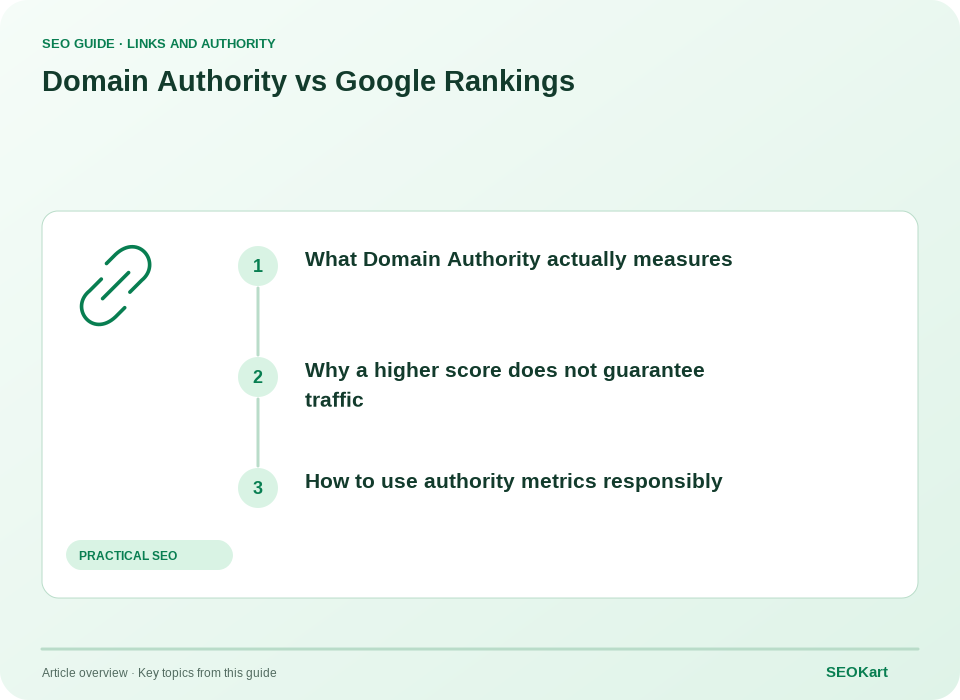
Domain Authority is a third-party comparison metric, not a Google ranking factor. Learn how to use it without confusing it with real search performance.
What Domain Authority actually measures
Domain Authority (DA) is a proprietary Moz metric that predicts a domain’s relative ability to rank based on signals in its link profile. It is not a score assigned by Google, and Google does not use Moz DA as a direct ranking factor. Other platforms offer different proprietary authority scores; a score of 30 in one system cannot be compared directly with 30 in another.
Why a higher score does not guarantee traffic
A website may have a high authority score but little traffic because its pages target irrelevant queries, are poorly structured or do not satisfy search intent. A smaller specialist website can outrank a large domain on a focused query when its page is more useful and relevant. Domain-level averages also hide differences between individual URLs. For more detail on this related topic, see SEO Backlinks: How to Evaluate Quality and Earn Relevant Links.
How to use authority metrics responsibly
Compare your site with genuinely similar competitors in the same market and track trends over time using the same provider. Investigate the quality and relevance of referring domains, not just the raw backlink count. Avoid buying links to inflate a metric; manipulative link schemes can create long-term search risks.
The measurements that matter more
In Google Search Console, examine non-branded impressions, clicks, queries, landing pages and average position over a meaningful date range. Pair these with qualified enquiries, organic conversions and whether priority service pages are indexed. Segment by country and device so a branded homepage click does not disguise weak commercial visibility. For more detail on this related topic, see How Google Search Rankings Work.
A practical review for Indian businesses
Start with five revenue-relevant service pages. Check their indexing, intended keywords, page titles, helpfulness and internal links. Review relevant competitors and identify missing explanations, examples, proof and customer questions. Use authority scores as secondary context when evaluating legitimate editorial mentions and links.
Where SEOKart can help
Our SEO audit services identify technical and content barriers, while link building services focus on relevant, defensible authority development. If you need a plan tied to enquiries rather than a vanity score, request a review.