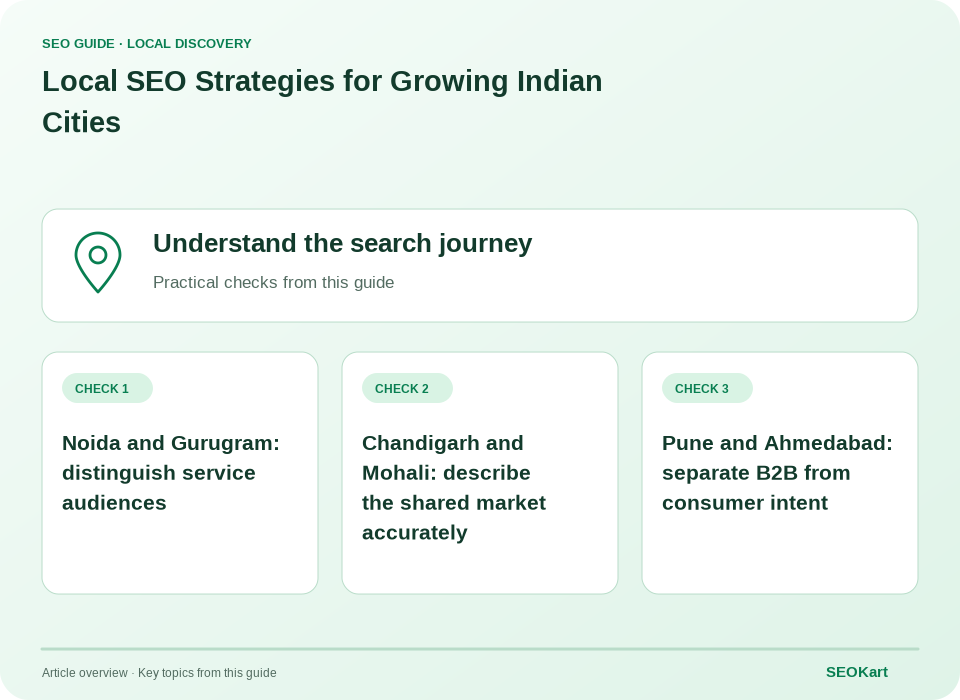
Businesses expanding into a new Indian city often assume they need dozens of location pages immediately. A better starting point is to understand the actual service footprint, customer questions and ability to fulfil enquiries. This guide focuses on practical expansion rather than unverified claims about which cities are growing fastest.
Noida and Gurugram: distinguish service audiences
Corporate buyers may need detailed capabilities and procurement information, while consumers need pricing context, location and fast contact options. Build pages around real services, not interchangeable city names.
Chandigarh and Mohali: describe the shared market accurately
If you serve both cities, explain actual coverage and operations. Avoid implying separate offices unless they exist. Show authentic examples of the types of customers you help.
Pune and Ahmedabad: separate B2B from consumer intent
Industrial and professional buyers may search for capabilities, specifications and consultation. Consumer audiences often prioritise availability, process and trust. For more detail on this related topic, see Local SEO Opportunities Across 10 Indian Cities.
Jaipur and Surat: make contact and service details clear
For local retailers, hospitality and service providers, hours, booking options, delivery areas and authentic business information can make the difference between a visit and an enquiry.
Indore, Kochi and Lucknow: test demand before scaling
Use Search Console queries, customer conversations and lead data to decide which services deserve dedicated pages. Do not infer keyword demand from a city’s general economic reputation.
Create location pages with evidence
Each useful page should explain a real service proposition, availability, distinctive customer needs and relevant proof where available. Do not invent testimonials, local offices or project results. For more detail on this related topic, see Small Business SEO Opportunities in Tier-1 and Tier-2 Indian Cities.
Strengthen the foundations
Check indexability, canonical tags, navigation and mobile contact forms. Maintain eligible business profiles and consistent business details. Earn reviews from real customers.
Expand based on qualified enquiries
Track leads and conversion rates for each service area. Improve pages that show relevant impressions before publishing additional location content.
Explore relevant services
See SEOKart city SEO pages, local SEO services and content marketing for supporting work.