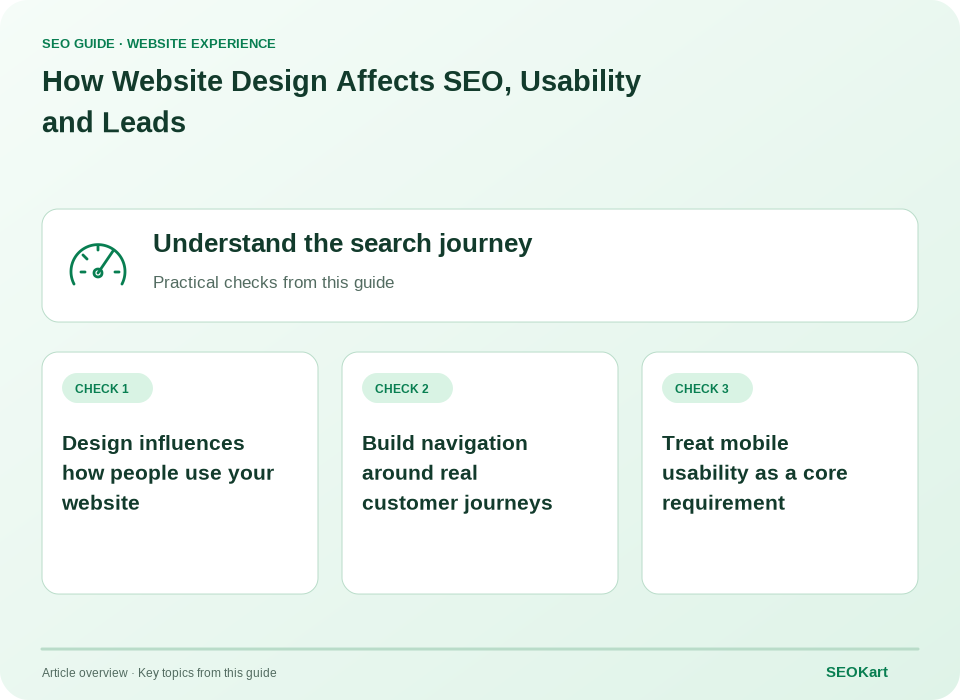
See how website design affects SEO through mobile usability, navigation, speed, accessibility and conversion-focused content.
Design influences how people use your website
Website design does not improve rankings simply because a page looks modern. It matters when layout, navigation, content presentation and performance make information easier to access. A beautiful homepage with hidden service details, confusing menus or slow loading can still frustrate visitors and search crawlers.
Build navigation around real customer journeys
Visitors should be able to move from the homepage to relevant services, locations, case studies and contact options without guessing. Use clear labels and crawlable links. For a service business, important commercial pages should be reachable through sensible navigation and contextual links rather than relying only on footer link collections.
Treat mobile usability as a core requirement
Check real phone layouts for readable text, tap targets, forms and menus. Avoid horizontal scrolling, overlapping buttons and elements that cover the content. Google primarily uses the mobile version of a site for indexing, so ensure important text and links are available on mobile, not only on desktop.
Prioritise speed and visual stability
Oversized hero images, heavy scripts and unstable page elements can slow the experience. Measure Core Web Vitals, including LCP, INP and CLS, and fix the biggest bottlenecks first. See Core Web Vitals explained and the website speed checklist for a practical starting point.
Use semantic content and accessible components
Keep a clear H1 and logical heading structure, descriptive links, visible focus states and appropriate image alt text. Do not put essential service copy inside images where search engines and assistive technologies may struggle to interpret it. Ensure forms provide labels, feedback and a clear way to complete an enquiry.
Measure SEO and business outcomes together
Review crawlability, indexing, organic landing pages and conversions before and after a redesign. A visual refresh is not a substitute for content relevance, and a redesign can harm SEO if URLs, internal links or canonicals change without planning. Use the website migration SEO checklist when rebuilding or moving a site.