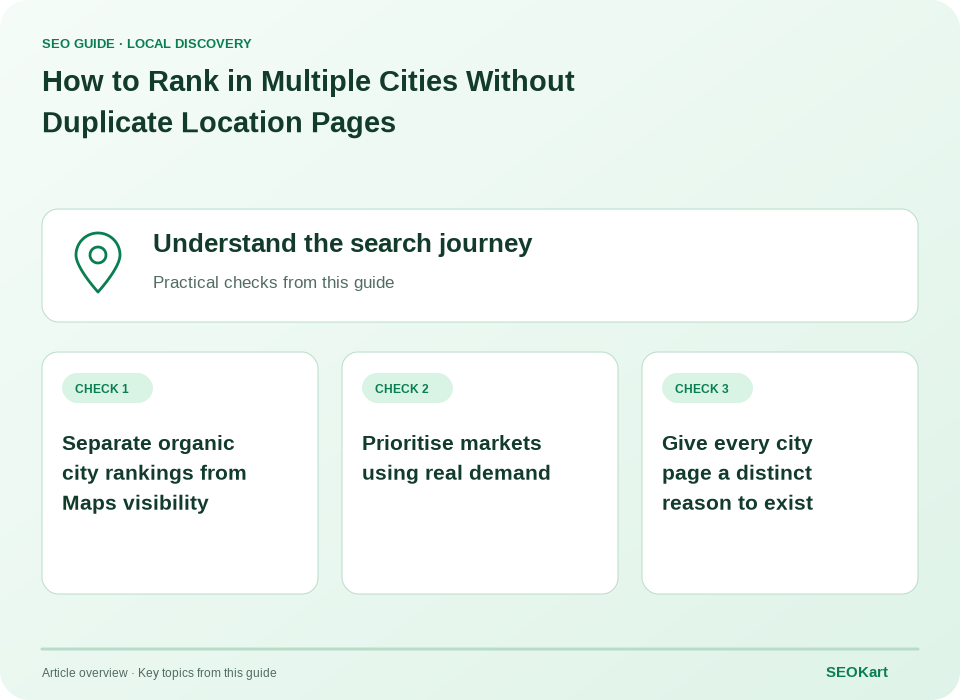
Ranking in several cities requires evidence that your business serves each market, not a collection of near-identical pages. Your website can target service searches across cities, while Google Maps visibility depends heavily on the searcher’s location and legitimate business presence.
Separate organic city rankings from Maps visibility
A service business can earn organic rankings for a city where it operates without maintaining a staffed office there. Google Business Profile eligibility is different: create profiles only for eligible real-world businesses and locations. A virtual office or a borrowed address does not automatically qualify. Service-area settings do not guarantee map rankings throughout a region.
Prioritise markets using real demand
Start with cities where you already deliver services and can demonstrate results. Compare enquiries, customer language, competitive pages and fulfilment capacity. A Delhi-based agency targeting Noida and Gurgaon should explain how it serves each market rather than claiming an office in every city.
Give every city page a distinct reason to exist
Build pages around actual market differences: customer problems, service coverage, local project examples, relevant FAQs, pricing considerations and proof. Replacing “Delhi” with “Mumbai” throughout an otherwise identical page creates thin, unhelpful content. If two markets cannot support distinct content, a regional page may be the better choice.
Build a navigable city-and-service structure
Link from core service pages to appropriate city pages and back to the primary service description. Use descriptive anchors that help readers choose the right location. Keep city navigation manageable; avoid sitewide blocks of hundreds of keyword-stuffed links. Provide clear contact details and an enquiry route on every page.
Support claims with trustworthy local evidence
Use real case studies, delivery examples, testimonials where permitted, and accurate service boundaries. Local organisations may link to genuinely useful work, but bulk directory submissions and paid link networks are poor substitutes for reputation. Keep business details consistent wherever you maintain legitimate listings.
Measure each city as its own market
In Search Console, review impressions and clicks for city pages and relevant queries. In analytics or your CRM, track calls, forms and qualified enquiries by landing page. Expect some cities to grow faster than others. Evaluate conversion quality rather than treating city keyword positions as the only outcome. For more detail on this related topic, see Local SEO Opportunities Across 10 Indian Cities.
Related SEOKart guides
Explore multi-city location page planning, local SEO in India, SEO services for the next steps.
Can I rank in a city without an office there?
Organic results can show relevant service pages for cities you serve. Google Maps rankings and Business Profile eligibility follow separate location and representation rules.
Should every city have a separate landing page?
Only when you can offer useful, distinctive information and genuinely serve that market. Avoid template-only pages made solely to capture similar searches.
Do service-area settings improve rankings across all cities?
No. A defined service area helps describe coverage but does not guarantee local pack visibility in each city.
How many city pages should I launch first?
Start with the markets you can support with credible information and measure enquiries before expanding.