Set up hreflang for multilingual and regional pages. Learn reciprocal tags, language codes, canonicals, x-default and validation checks.
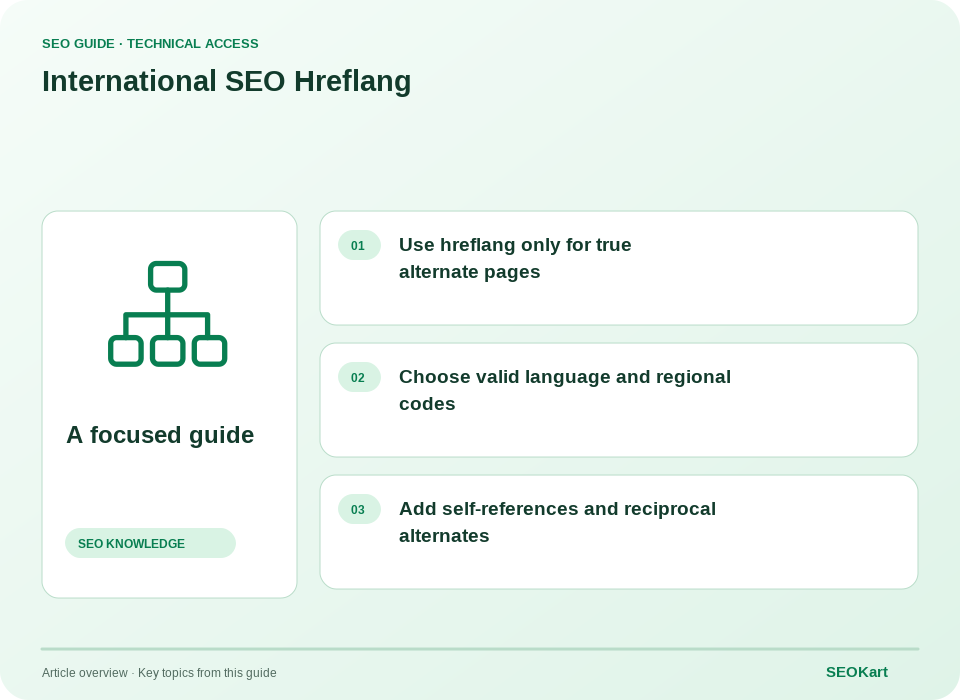
Use hreflang only for true alternate pages
Hreflang connects pages that serve substantially equivalent purposes for different languages or regions. An English page for India and an English page for the UK may be alternates when each is tailored to its market. Do not connect unrelated service pages simply because they share a category.
Choose valid language and regional codes
Use recognised language codes such as en or fr, with optional regional subtags such as en-IN or en-GB. A country code alone is not a valid language value. Create a documented mapping of every translated or regional URL before adding tags. Keep naming consistent across the site.
Add self-references and reciprocal alternates
Each alternate should declare itself and its equivalent versions. If the India page references the UK page, the UK page must reference the India page. Missing return links can undermine the signal. Include every member of an alternate cluster in the mapping, and update the cluster whenever a page is added or removed. For budgeting decisions, see International SEO Pricing: Currency Conversion vs Market Scope.
Align canonical tags with the regional strategy
Regional pages intended to appear independently should generally use self-referencing canonicals rather than canonicalising all variants to one country. Hreflang does not override a noindex tag or fix a broken canonical. Verify final URLs return 200 responses and are crawlable before troubleshooting alternate annotations.
Choose one implementation method
HTML head annotations, XML sitemap annotations and HTTP headers can all express hreflang. Use a consistent, maintainable approach; multiple methods are not necessary. For large sites, sitemap-based annotations can be easier to manage, provided the generated links remain complete and reciprocal. Review the XML sitemap guide when planning this.
Test real country experiences and monitor errors
Check translated navigation, currencies, local contact details, shipping or service availability, and mobile usability. Avoid forcing redirects solely by IP because crawlers and users need access to all versions. Crawl alternate clusters after deployment and inspect Search Console indexing. See the India SEO strategy for market-first planning.