Search intent is the goal behind a query. Two searches can mention the same service while requiring completely different answers. Matching that goal is often more important than repeating the exact keyword.
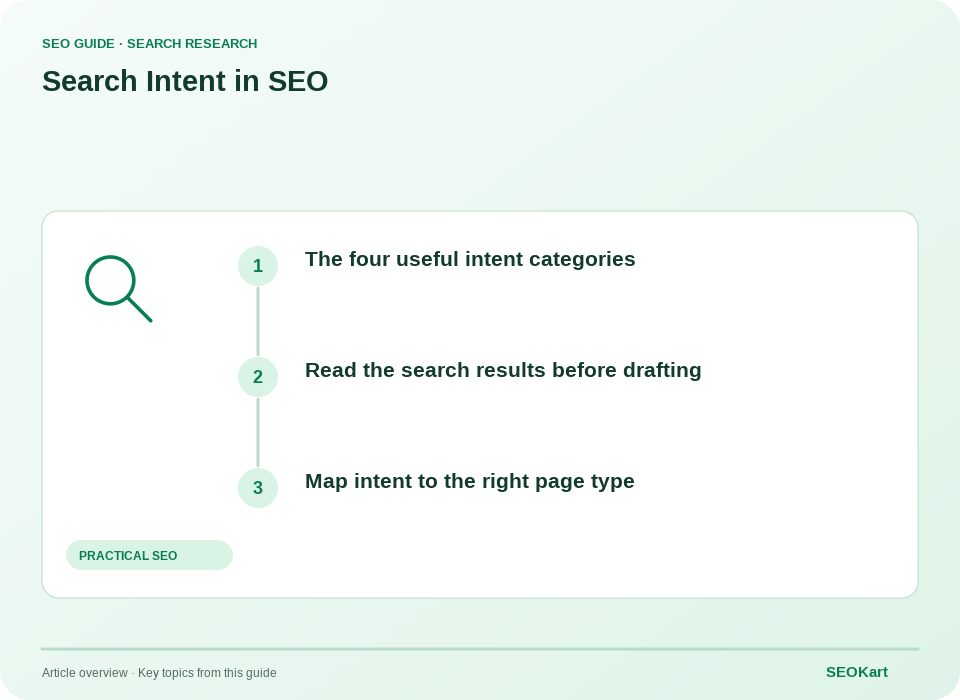
The four useful intent categories
- Informational: “what is local SEO” calls for a clear explanation.
- Commercial: “best SEO agency for hotels” suggests comparison and evaluation.
- Transactional: “SEO audit service pricing” suggests a service offer and a next step.
- Navigational: “SEOKart contact” suggests a direct route to a known destination.
Read the search results before drafting
Search for the target phrase and review the types of pages Google presents. A results page dominated by tutorials suggests a guide; one dominated by service providers suggests commercial intent. Note the questions, comparison criteria and information gaps without copying competitors. For the implementation checks, see On-Page SEO Checklist for Business Websites.
Map intent to the right page type
A service landing page should explain scope, deliverables, suitable customers, process, pricing where applicable and how to enquire. An educational article should answer the question directly, provide examples and link to a relevant service when the reader is ready.
When keywords overlap
“SEO company Delhi” and “SEO agency in Delhi” may belong on one strong commercial page. “How to choose an SEO agency” deserves its own guide. Creating separate near-identical pages for every wording variation can split relevance and weaken navigation. For more detail on this related topic, see How Long Should SEO Content Be? Match Depth to Search Intent.
Check for intent mismatch
- Identify the primary question or buying task.
- Compare it with the format of pages ranking for the query.
- Review whether your introduction answers the task quickly.
- Check whether headings cover the decision criteria users need.
- Make the next action appropriate: learn more, compare packages or request a quote.
Measure and refine
Use Search Console to find pages earning impressions for queries they do not clearly address. Improve the existing page where intent overlaps; create a new page only where the user need is genuinely different. Our SEO audit can help assess content intent alongside technical issues, while content marketing services help turn those findings into a usable content plan.