Learn how keyword stuffing damages readability, how to spot unnatural repetition and how to optimise pages around intent instead.
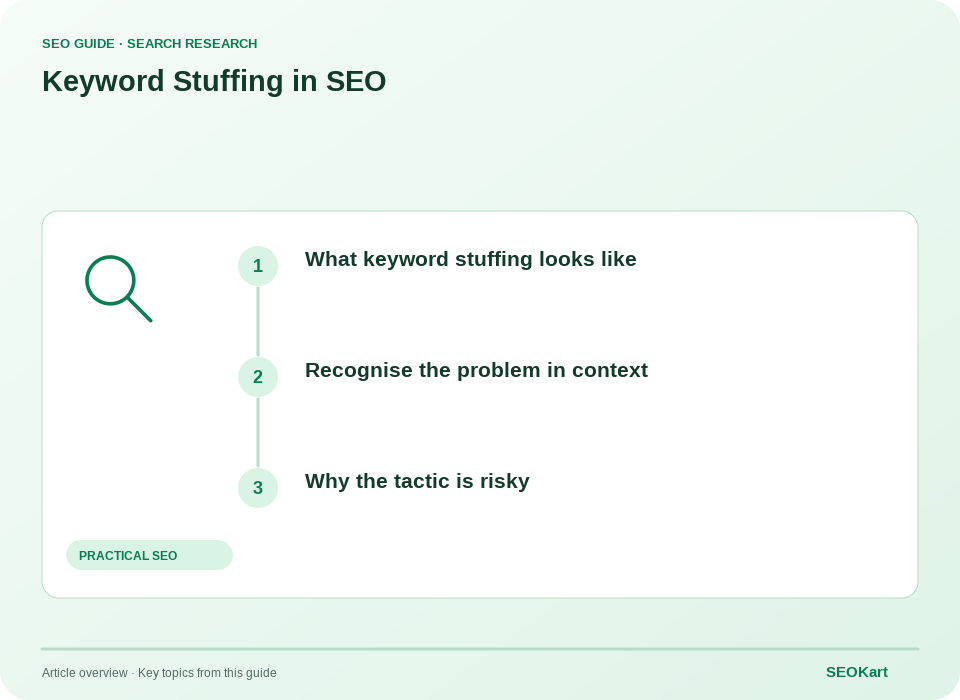
What keyword stuffing looks like
Keyword stuffing is the excessive or unnatural repetition of search terms to manipulate rankings. It may appear in paragraphs, headings, image alt text, footer lists or hidden elements. A phrase repeated in every sentence rarely helps a customer understand the service and can make a page look untrustworthy.
Recognise the problem in context
A local service page that repeats “best SEO agency Delhi” dozens of times without describing services, process or evidence is not more useful because of the repetition. Lists of city names added solely to attract unrelated searches are another warning sign. Natural mentions of the business location and service are fine when they serve the reader. For more detail on this related topic, see How to Do Keyword Research for Your Business in 2026.
Why the tactic is risky
Search engines aim to reward pages that satisfy queries, not those that mechanically repeat them. Keyword stuffing can violate spam policies and undermine the clarity of the page. Even without a ranking penalty, visitors may leave when copy reads like an advertisement written for a robot.
Write for intent and coverage instead
Choose a clear topic and answer the questions a prospective customer needs resolved. Use related terminology where accurate, explain deliverables and limitations, and include concrete examples. A page about SEO services should make it easy to understand what the service includes rather than repeating the phrase in every heading. For more detail on this related topic, see How to Write SEO-Friendly Content That Helps Customers.
Audit and repair existing pages
Read the page aloud, identify repeated phrases that add no meaning, and remove keyword lists that do not help navigation. Consolidate near-duplicate sections and replace generic claims with practical details. Check title tags and meta descriptions for accuracy, but do not strip out every natural keyword mention.
Measure whether the revision helps
After editing, check relevant queries and engagement in Search Console and analytics. Compare meaningful leads and search visibility over a suitable period; short-term fluctuations do not prove the rewrite caused a ranking change. An SEO audit can also reveal other issues affecting performance.