Find commercially relevant keywords, group them by search intent, map them to useful pages and prioritise opportunities that generate enquiries.
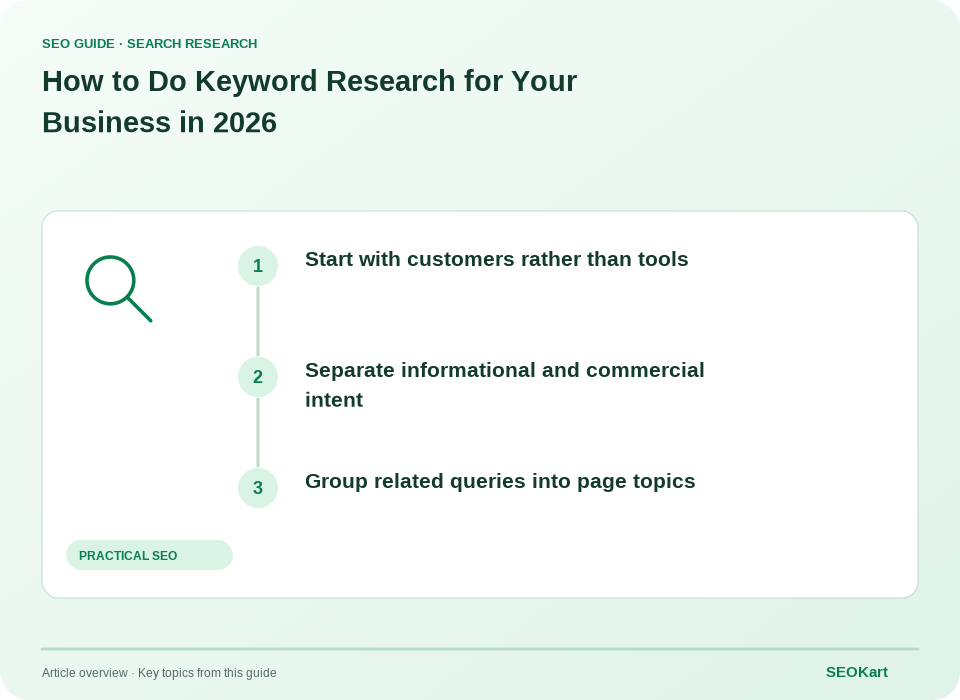
Start with customers rather than tools
List the services you actually sell, the locations you serve and the questions prospects ask before buying. For a website design agency, “website redesign cost” and “WordPress maintenance company” may signal different needs. Speak with sales and support teams to collect the language customers use instead of relying only on high-volume keyword lists.
Separate informational and commercial intent
A search for “what is technical SEO” often needs an explanation; “technical SEO audit agency” suggests evaluation of a provider. Inspect the kinds of pages already appearing for each query. Match educational topics to guides and buying-stage terms to specific service pages. The search intent guide explains the differences.
Group related queries into page topics
Do not create a new page for every slight keyword variation. Combine phrases that represent the same customer need, then give that topic one strong page. Keep genuinely different services, cities or audiences separate when the content can be meaningfully distinct. This reduces overlapping pages and makes internal linking more useful. For more detail on this related topic, see Keyword Stuffing in SEO: Risks, Examples and Better Alternatives.
Assess business value and realistic competition
Estimate how closely a keyword relates to a profitable service, what kind of enquiry it could attract and whether the business has evidence to satisfy the search. Search volume can guide scale but should not decide priorities alone. Smaller, specific terms can be valuable when they match a clear buying need.
Build a practical keyword-to-page map
Create a sheet with the query group, intent, target page, page purpose and next action. Mark whether each page should be improved, created or consolidated. Connect related guides to commercial pages using natural links. Use the internal linking strategy to help customers navigate between stages.
Review results and adjust quarterly
Use Google Search Console to see which queries already surface your pages and where impressions fail to become relevant visits. Compare leads and sales outcomes, not just ranking positions. Update priorities when services, competitors or customer language change. The SEO ROI guide helps connect research to business results.