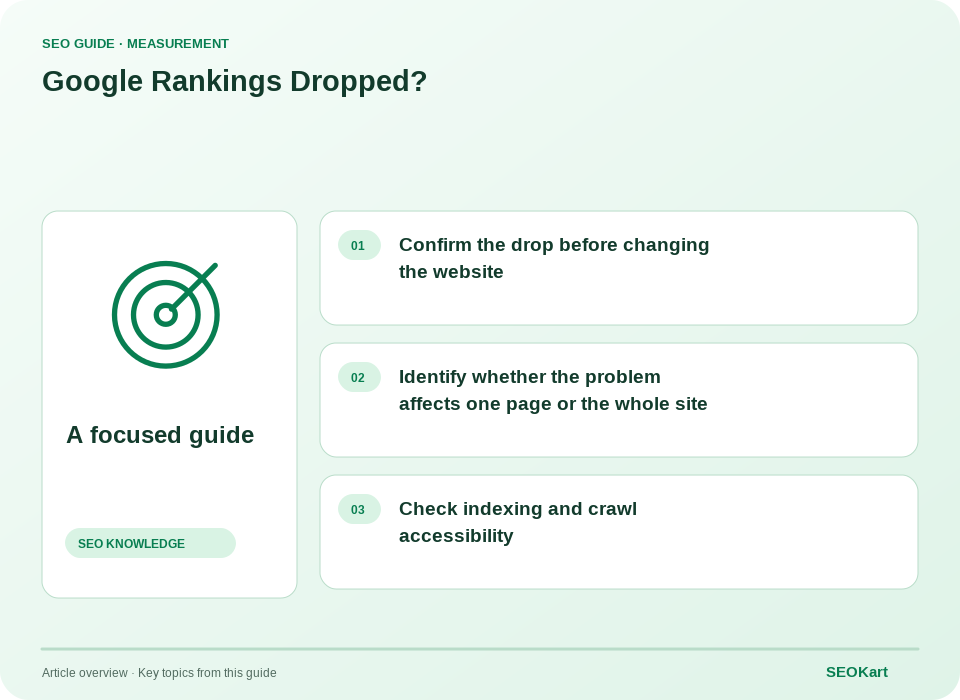
Investigate lost Google rankings with Search Console, indexing checks, technical audits and content comparisons before making risky changes.
Confirm the drop before changing the website
Compare clicks, impressions, average position and conversions over meaningful date ranges. Segment branded versus non-branded searches, countries, devices and individual landing pages. Seasonal demand can reduce clicks even when positions remain stable. Search Console data may be delayed or revised, so avoid reacting to one unusual day.
Identify whether the problem affects one page or the whole site
A single declining page often points to intent mismatch, competing content, a lost link or a technical change. A sitewide decline calls for checks of hosting, robots rules, templates, canonicals and major algorithm updates. Group affected pages by directory and content type to locate the pattern before rewriting everything. For more detail on this related topic, see Can AI Improve Google Rankings? Practical Uses and Limits.
Check indexing and crawl accessibility
Inspect affected URLs for 200 responses, unintended redirects, noindex directives, robots restrictions and canonical mismatches. Check whether Google selected a different canonical or reports a crawl failure. Review indexing troubleshooting and crawl error diagnosis. A page cannot regain visibility if Google cannot access the intended content.
Compare the search results and user intent
Review current search results for queries that lost positions. Google may now favour product pages, local results, recent comparisons or concise explanations instead of the old format. Update pages to answer the current need with accurate details, clear evidence and useful next steps. Do not simply repeat keywords more often or copy a competing article. For measurement and reporting, see Domain Authority vs Google Rankings: What Businesses Should Measure.
Review recent site changes and competing pages
Look for deployment dates, redesigns, URL changes, navigation edits, removed paragraphs, altered titles and new duplicate pages. Check whether two pages on your own site target nearly the same query. Compare the affected URLs against a backup or change log. The redesign SEO checklist helps isolate migration-related causes.
Prioritise fixes and measure recovery
Correct access and indexing problems first, then repair broken internal links and address clear content gaps. Track changes in a dated log so the outcome can be measured. Avoid deleting large sections, buying backlinks or repeatedly changing titles without evidence. Rankings may recover at different speeds depending on the cause and recrawl frequency.